
A quitclaim deed just landed on your Wilmington kitchen table, and whether it arrived by mail, through a lawyer, or hand-delivered by someone you know, it probably came with more questions than answers. This blog is to be treated as general information, not legal advice.
A quitclaim deed in North Carolina transfers only the ownership interest the signer actually holds. It does not promise clean title. It also does not erase mortgages, tax liens, or HOA debt. Below, you will learn how these deeds work, when they backfire, and what safer options exist for Wilmington properties.
What a Quitclaim Deed Is (and Isn’t) in North Carolina
A quitclaim deed passes whatever interest the grantor holds, if any, with no title promises. The new owner takes the property exactly as it stands. That means clear title, cloudy title, or no real interest at all. What makes a deed a quitclaim is its language and its lack of warranties.
| Deed type | Title promises | Typical use |
| General warranty deed | Seller guarantees clear title back through the chain of ownership | Standard Wilmington home sales |
| Special warranty deed | Seller guarantees only problems created during their own ownership | Sales where the seller limits liability |
| Quitclaim deed | None; the buyer takes whatever interest exists | Family, spouse, LLC, and heir transfers |
In a regular home sale between strangers, you would normally see a warranty-type deed instead. A quitclaim deed is a paperwork tool for specific situations, not a full-protection sales deed.
Common quitclaim deed uses for a Wilmington homeowner include:
- Adding or removing a spouse after marriage or divorce, when both sides agree
- A parent transferring an interest to a child for estate planning or financing
- Consolidating heir property in North Carolina among cooperating siblings or cousins
- Moving a rental into an LLC that you already control
A quitclaim deed does not fix several problems that people often expect it to solve:
- An existing mortgage stays in place and still must be repaid
- Property tax liens and city liens remain attached to the land
- HOA or condo dues already owed do not disappear
- Cloudy title and missing heirs stay unresolved
Whatever mess is attached to the property travels with your share. You may hand that problem to the next owner along with your ownership interest.
Local buyers like ILM Home Offer review title history closely for this reason. Old quitclaim deeds often appear in the chain on inherited Wilmington houses. We work with North Carolina closing attorneys to sort out what each deed really transferred.
When a Quitclaim Deed Helps and When It Backfires
A quitclaim deed works when everyone agrees and title surprises are unlikely. It backfires when people guess instead of getting legal advice. Cooperation and clarity matter far more than speed. The deed is only paper reflecting a deal that is already settled.
Safer uses usually look like this:
- Cooperative spouses adding or removing a name after agreeing who keeps the house
- Parent-to-child gifts of an interest in the property
- Moving a Wilmington rental into an LLC you own
- Siblings in New Hanover or Brunswick County consolidating inherited ownership so the house can be sold
Risky uses are different:
- Quick-cash offers from strangers who want only a quitclaim deed
- Foreclosure rescue pitches promising to take over your payments
- Signing before the divorce separation agreement or court order is final
- Family transfers where a relative promises to pay a mortgage that you still owe
Without a title search and title insurance, the new owner inherits tax liens, judgments, and surprise co-owners. Older coastal houses that passed through several relatives are especially risky. One rushed deed can trigger lawsuits or a blown sale years later.
Most people sign these deeds to keep the peace, help a struggling relative, or avoid an inheritance fight. Those intentions are good, but North Carolina law still treats the deed as a real transfer.
Treat a quitclaim deed as a binding transfer rather than a favor you can undo. If it feels like a shortcut around court orders or the bank’s approval, it probably stores up trouble. Flood-zone status can also complicate coastal deals, so read about selling a house in a flood zone in North Carolina.

How to Prepare and Sign a North Carolina Quitclaim Deed
A valid deed needs accurate information, clear agreement, and a notarized signature. Small errors can cause rejection at the Register of Deeds or title trouble later. Follow these steps in order.
Gather these items before you meet the attorney or notary:
- The most recent recorded deed and the full legal description
- Government-issued photo identification for every signer
- Names of any spouses who may hold marital rights
- A written agreement among all parties about exactly what is being transferred
- Mortgage statements, tax bills, and any HOA or lien notices
- Pull the last recorded deed from the county Register of Deeds. Copy names and the legal description from it, not from memory.
- Decide exactly who is transferring, who is receiving, and how the new owners will hold title.
- Have a North Carolina real estate attorney draft or review the deed. Internet templates often miss local requirements.
- Ask your attorney to identify the drafter and confirm that every name matches the prior deed.
- Sign before a notary. State law says deeds must be acknowledged by the grantor before registration.
- Bring any spouse who must release marital property rights. Your attorney can say who must sign.
- Check for blanks, typos, and legal-description errors before leaving the notary.
Names deserve special care. Missing middle initials or misspelled last names can cause headaches when you sell or refinance. Compare every name against the prior deed and the grantor’s identification.
Heirs who live out of town can often sign before a local notary and mail the original back. A mobile notary can also travel to you. A clean, properly acknowledged deed today saves you from a rejected form later. It also spares your family from expensive title cleanup down the road.
How to Record a Quitclaim Deed in Wilmington
A deed does not bind lien creditors or later purchasers until registered in the county where the land lies. Recording protects your priority. It must happen in the county where the property sits, not where you live. An unrecorded deed left in a drawer invites conflicting deeds and liens.
- Confirm the county. Wilmington-area addresses may sit in New Hanover, Brunswick, or Pender County.
- Check that every blank is filled and the notary acknowledgment is complete.
- Confirm the current office address, hours, fees, and accepted payments with that Register of Deeds.
- Deliver the original deed with the recording fee and any excise tax, in person, by mail, or electronically where offered.
- Request a stamped copy, or check the online index to confirm names and the legal description.
- Keep the recorded copy with your important papers and share it with any lender or title company.
Prompt recording protects you in several ways:
- It keeps your place in line ahead of later liens or conflicting deeds
- It puts the transfer into the public record where title searches will find it
- It prevents confusion years later about whether an old deed was valid
Recording does not change who owes on an existing mortgage. The lender can still hold the original borrower responsible until the loan is paid off or refinanced. Many closing attorneys handle recording as part of a sale, which removes this step from your plate.
Recording Fees, Excise Tax, and Property Taxes
Recording a quitclaim deed involves fees, a possible excise tax, and property tax questions. Confirm exact amounts with the Register of Deeds or an attorney before budgeting.
Ask the Register of Deeds these questions before you pay:
- What is the current recording fee, and are extra pages charged?
- Is the deed on the correct paper size and formatted to recording standards?
- Does my transfer qualify for any excise tax exemption?
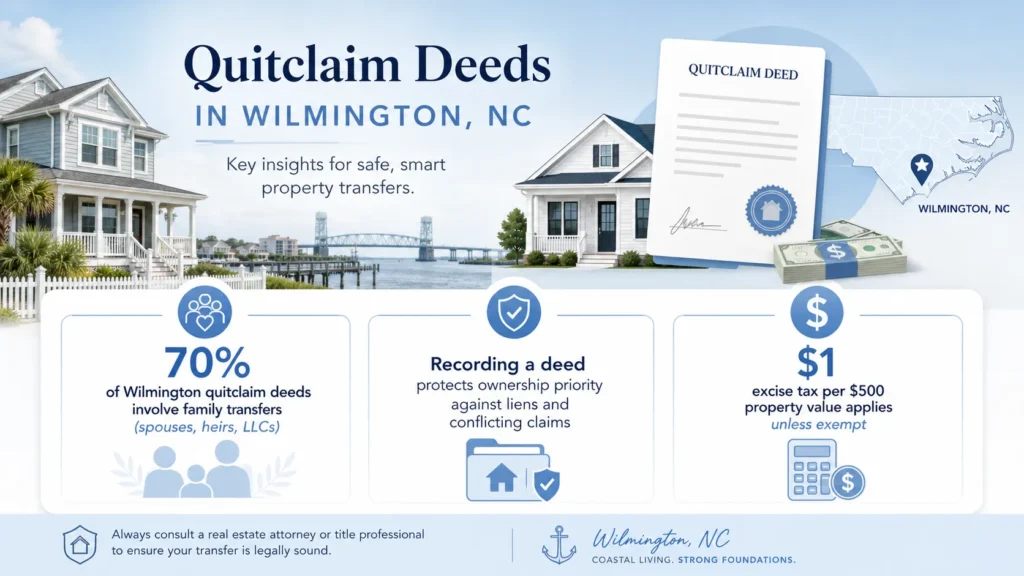
Recording fees are uniform statewide under G.S. 161-10 and posted in each office. The state excise tax on conveyances is $1 per $500 of value, collected before recording. Some transfers are exempt, so ask before assuming.
| Cost or issue | What to know |
| Recording fee | Check the county schedule, including extra-page charges for long deeds |
| Excise tax | $1 per $500 of value unless exempt; verify any local transfer tax in New Hanover, Brunswick, or Pender County |
| Attorney and title costs | Professional fees often prevent costlier cleanup later, especially on inherited property |
| Liens and unpaid taxes | They follow the property; a new deed does not erase them |
| Property tax value | A change in ownership or use may affect valuation, so call the county tax office |
Local assessments also shift your bill. Read our guides to the New Hanover County property revaluation and Brunswick County property taxes explained.
A cheap DIY deed can cost more if liens or family disputes surface later. What matters most is your net result, not the line items. Sometimes a clean sale that pays off liens at closing leaves you more cash and fewer headaches. Ask your county tax office whether a change in ownership affects exemptions or billing.
Spouses, Mortgages, and Common Mistakes
A quitclaim deed changes who owns the property, not who owes the mortgage. If your name stays on the loan, the lender can still pursue you. That surprise hurts most people who “signed the house over” and walked away.
Many mortgages contain due-on-sale clauses that let lenders demand full repayment after a transfer. Federal law, including 12 U.S.C. 1701j-3, limits enforcement for certain family transfers. Those protections are narrow, so never assume your lender will ignore a transfer.
| Common mistake | Why it hurts |
| Skipping a required spouse | A missing signature can derail a later sale or refinance |
| Believing the deed cancels the loan | Only payoff or refinancing removes your name from the debt |
| Using an out-of-state form or partial legal description | Rejection or title questions when someone tries to sell |
| Leaving a signed deed unrecorded | The public record still shows the old owner |
| Signing before divorce terms are final | You lose leverage and clarity about what you are owed |
| Skipping the lender conversation | Transfers without consent can trigger due-on-sale demands |
| Heirs deeding property without informed consent | Family fractures and invites legal challenges |
| Accepting pressure to sign quickly | Deed fraud targets elderly and out-of-town owners |
Divorce and inheritance add another layer. Signing away your interest before a separation agreement or court order is final can leave you without leverage. In an estate, one heir quietly deeding property to themselves can fracture a family.
Before you sign anything, ask yourself these practical questions:
- Is my name still on the mortgage, and will the lender consent to the transfer?
- Does a spouse or heir also need to sign?
- Has anyone run a title search?
Alternatives to a Quitclaim Deed and Next Steps
A quitclaim deed is usually one piece of a bigger legal picture. In divorce, separation agreements and equitable distribution orders decide who keeps the house. In inheritance, probate rules control how property passes. The deed only carries those decisions onto the public record.
In divorce and inheritance, the deed should follow the legal process, not lead it:
- Divorce: sign only after the separation agreement or equitable distribution order settles the house
- Inheritance: probate and estate rules control the transfer, and one heir’s deed moves only that heir’s interest
- Pressure: if you feel rushed, hire your own family-law or probate attorney before signing
Common alternatives include:
- A warranty deed in a standard sale, backed by title insurance
- Wills and trusts prepared by a North Carolina estate-planning attorney
- Court orders in divorce or estate cases, with the deed following behind
- A normal listed sale through a closing attorney
Ask an attorney whether transfer-on-death tools currently exist for North Carolina real estate. Rules can change, and online forms are poor guides.
If you plan to use a quitclaim deed on a Wilmington-area property anyway, work through this checklist first:
- Confirm the county and pull the last recorded deed
- List every owner and every spouse who may hold marital rights
- Look for unpaid taxes, HOA notices, and city liens
- Order a title search from a closing attorney or title company
- Talk to a North Carolina real estate or family-law attorney
- Decide whether a quitclaim deed, a sale, or a court order is the right tool
- Consider flood zones, coastal rules, and HOA limits if one heir keeps the home
If the paperwork feels heavier than the house is worth, compare a direct as-is sale. ILM Home Offer buys Wilmington houses as-is. We work with closing attorneys on deed language, spousal signatures, lien payoffs, and recording. Sellers should also review the North Carolina seller disclosure form before choosing a path.
A direct sale typically means no repair project before listing, no commissions, and no waiting on a buyer’s lender. Everyone gets a clear picture of net proceeds before closing. That clarity often beats months of family paperwork.
FAQs: North Carolina Quitclaim Deeds
Do you need a lawyer to transfer a deed in North Carolina?
No law requires one for every transfer, but closing attorneys usually handle deeds because title, recording, and tax issues overlap. For divorce, inheritance, or debt, have a North Carolina attorney review the plan first.
Can I transfer a deed myself in NC?
Yes, but mistakes in language, legal description, or signatures can cause rejection or title problems. At minimum, have a North Carolina attorney review your draft before you record it.
What is the difference between a quitclaim deed and a warranty deed in NC?
A warranty deed promises clear title and is often backed by title insurance. A quitclaim deed passes only the signer’s interest, with no guarantees. Typical Wilmington sales use warranty-type deeds.
How much does it cost to record a quitclaim deed in NC?
Expect a statutory recording fee, possible extra-page charges, and excise tax of $1 per $500 unless exempt. Confirm current amounts with your county Register of Deeds or closing attorney.
Can I sell my Wilmington house as-is instead of using a quitclaim deed?
Yes, if all owners agree. Cash buyers like ILM Home Offer purchase as-is. They work with closing attorneys on deeds, lien payoffs, and recording, so you avoid the paperwork.
Will a mortgage or my ex-spouse’s name on the deed scare off a cash buyer?
Usually not. Responsible buyers plan for existing mortgages and complicated ownership. The closing attorney pays off the loan at closing and collects every required signature, including any spouse with rights.