


Looking for a flood insurance renewal for your Wilmington house? The number that comes up will make your stomach drop. The yard still shows where the last storm pooled up, and the thought that you might be stuck here forever is starting to feel real.
Selling a house in a flood zone in North Carolina is harder than selling one outside the lines, because insurance costs, lender rules, and buyer nerves all pile on at once.
The good news is you still have options in Wilmington and coastal NC, whether that means listing on the MLS with a plan or taking a straightforward as-is cash offer so you can move on.
Let’s walk through what your flood zone actually means, how it affects buyers, what North Carolina expects you to disclose, and the real paths you have to sell.
Why Selling a Flood-Zone House in North Carolina Feels So Much Harder
You’ve already had a buyer back out after their lender saw the flood map and insurance quote, and now you’re staring at a cancellation addendum wondering if anyone is ever going to stick with a contract.
Selling a house in a mapped North Carolina flood zone usually means a smaller pool of buyers, tighter lender rules, and more chances for a deal to fall apart at the last minute.
Here is how that plays out around Wilmington:
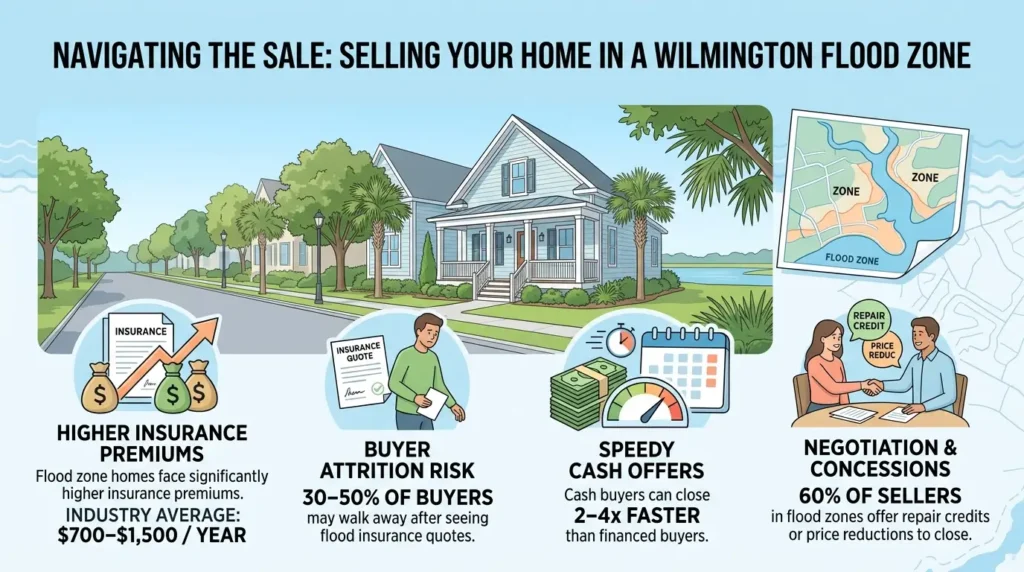
- Flood zones and lender rules. FEMA maps Special Flood Hazard Areas, including zones like AE and VE, where flood risk is treated as higher. For many buyers using federally backed loans, the lender may require flood insurance, as FEMA explains on its flood insurance page.
- Insurance shocks kill deals. A buyer falls in love with your place, writes an offer, and then gets a real flood insurance quote. That monthly premium gets added into their debt-to-income math. Sometimes that extra cost pushes them past what their lender will allow, and many just walk.
- Property-specific risk pricing. FEMA’s Risk Rating 2.0 looks more closely at each property’s risk factors. That can mean two Wilmington houses near each other get very different insurance quotes.
- More false starts. Flood-zone homes here can face more showings that go nowhere and more conditional offers that crumble once lenders and insurers dig in.
For a wider look at how the broader Wilmington market is behaving right now, scan ILM’s Wilmington real estate market trends; flood-zone homes live inside that same backdrop, just with more friction layered on top.
Understanding Your NC Flood Zone and Wilmington’s Real Flood Risk
In plain English, your flood zone label is the government’s way of showing mapped flood risk, and that label affects buyer comfort, lender rules, and what insurance companies may charge.
What Common NC Coastal Flood Zones Mean
- Zone AE. A higher-risk flood area, often along rivers, creeks, or low-lying areas.
- Zone VE. Coastal areas where wave action is a concern, including beach-adjacent spots on barrier islands.
- Zone X (shaded or unshaded). Generally treated as lower risk than AE or VE, though lower risk does not mean no risk.
How to Look Up Your Flood Zone in North Carolina
1. Go to FEMA’s Flood Map Service Center: https://www.fema.gov/flood-maps
2. Type in your Wilmington or coastal NC address and search.
3. Zoom to your parcel and check the zone code (AE, VE, or X).
North Carolina also provides a state flood-risk portal at flood.nc.gov, where you can type in an address and view flood maps.
If you’re also trying to understand how flood risk fits into broader neighborhood demand, ILM’s Wilmington real estate market trends can give you more context.
Maps vs. Actual Water in the House
Being inside a mapped floodplain is not the same thing as having water in your living room. Some Wilmington homes in AE or VE have never taken on interior water. Buyers, inspectors, and insurers care about both the map and the real-world history.
Base Flood Elevation and Elevation Certificates
Base Flood Elevation (BFE) is the height floodwaters are expected to reach during a major storm. An elevation certificate compares the height of your home’s lowest floor to that BFE. If your home sits well above it, that can ease some buyer and lender worries.
How a Flood Zone Can Change Your NC Home’s Value, Buyer Pool, and Offers
Being in a flood zone often puts downward pressure on what buyers are willing to pay, but it does not work like an automatic percentage cut.
Pricing and Discount Pressure
Buyers tend to look at the zone label, the home’s elevation, the quality of construction, and whether there’s a history of water inside the house. Repeated or recent flooding or lingering mold concerns tend to push buyers toward deeper discounts.
Insurance Costs as Another Monthly Payment
Flood insurance premiums act like another monthly housing cost in buyers’ minds. This often shows up as:
- Lower offers than you’d see for a similar non-flood-zone home.
- Buyers asking for bigger repair credits or closing cost help.
- More cash-only buyers, because they’re not bound by lender debt-to-income rules.
Net Proceeds: What You Clear vs. What You List For
If you list high, sit for a long stretch, pay flood insurance and taxes, then end up dropping the price and eating closing costs, your top-dollar strategy can quietly drain away your net proceeds.
For a deeper dive into all the typical costs, see ILM’s breakdown of the costs you may face when selling your house in Wilmington.
NC Disclosure Rules, Flood History, and Insurance: What You Have to Tell Buyers
In North Carolina, you’re expected to be honest about known flood-zone status and known flooding when you sell. Being upfront protects you far more than trying to hide problems.
The Key NC Disclosure Forms
- The Residential Property and Owners’ Association Disclosure Statement.
- The Mineral and Oil and Gas Rights Disclosure.
NC-focused resources like flooddisclosure.us’s North Carolina page explain that sellers are expected to answer questions truthfully about known flood-zone status, past flooding, and existing flood insurance policies.
UNC School of Government materials on floodplain FAQs and property issues help explain how flood-related information can affect North Carolina property owners.
Flood Insurance and Buyers’ Loans
You can sell your property without a current flood policy, but many buyers using federally backed loans will run into mandatory flood insurance requirements in certain high-risk zones, as explained by FEMA’s flood insurance guidance.
Why Honesty Is Your Best Protection
Flood disclosure rules and forms can change, so check current guidance, including the Association of State Floodplain Managers update on North Carolina flood disclosure, before relying on any legal detail. This article is informational, not legal advice.
Elevation Certificates, Base Flood Elevation, and Whether They’re Worth It in NC
An elevation certificate is a document — usually prepared by a licensed surveyor or engineer — that shows your home’s elevation relative to the Base Flood Elevation. Insurers use that information to more accurately price flood policies, as FEMA explains on its elevation certificate guidance page.
Being clearly above BFE can sometimes help lower flood insurance premiums. Talk with your insurance agent about whether getting one is likely to move the needle enough to justify the cost in your specific situation.
Your Real Options for Selling a House in a Flood Zone in North Carolina
You have a handful of paths to get out from under a flood-zone property in North Carolina, and each one trades price, time, and hassle differently.
| Option | Typical Timeline | Out-of-Pocket Cash | Fall-Through Risk | Hassle Level | Notes |
| List on the MLS as-is | Tied to showings, inspections, appraisal, loan approval, closing | Lower upfront; ongoing insurance, taxes, utilities while listed | Higher — financed buyers can hit snags | Medium to high | Might hit a higher sticker price but can give back a lot in time, carrying costs, and repair credits. |
| Do targeted repairs then list | Longer — complete work first, then traditional sale | Higher: contractors, materials, plus ongoing insurance and taxes | Medium — polished home can calm some buyers but flood zone still applies | High | If repairs boost buyer confidence, you may improve price and speed, but easy to overspend. |
| Rent it out | Income starts once tenant found; selling deferred | Ongoing insurance, maintenance, vacancy, management fees | Medium — risk shifts to long-term ownership | High | Can work if numbers are strong, but you stay on the hook for flood risk. |
| Government / hazard-mitigation buyout | Often slow — dependent on program rules and funding | Avoid major repairs, but carry costs while waiting | Lower once accepted — not lender-driven | High on paperwork | Limited to certain disaster-affected areas; not an option for most sellers. |
| Sell as-is to a local cash buyer like ILM | Often simpler and less dependent on outside approvals | Very low: no repairs, no showings prep | Lower — no lender underwriting or flood insurance approval needed | Low | Trade some top-of-market price for speed, certainty, and stopping insurance/repair/tax payments. |
If you want to see exactly how a local cash-buyer process works from start to finish, read ILM’s overview of how we buy houses.
If You Do List It: Step-by-Step Prep and Marketing for an NC Flood-Zone Home
If you’re going to list a Wilmington or coastal NC flood-zone property, a simple, honest plan will serve you much better than either downplaying the risk or overspending on last-minute projects.
1. Confirm your flood zone and gather documents. Print or save screenshots from FEMA’s map and North Carolina’s portal. Put any elevation certificates or mitigation paperwork in one folder.
2. Talk with your insurance agent about current and sample buyer quotes. Know what a new policy for a buyer might look like and whether any mitigation you’ve done is reflected.
3. Pick repairs that pay off before listing. Fix visible water damage, address small grading or drainage problems, and clean up musty areas. Think confidence builders, not full renovation.
4. Be realistic with your pricing strategy. Look at sales for similar homes inside and outside the floodplain, and price in a way that accounts for what buyers will face in insurance.
5. Write honest, clear marketing remarks. State the flood zone, note any mitigation steps taken, and if accurate, mention years with no interior flooding.
6. Aim your efforts at the right buyers. Investors, second-home buyers, and locals who already understand Wilmington floodplains often move faster.
7. Set a personal deadline and backup plan. Decide how long you’re willing to wait before revisiting your strategy, and be ready to consider a direct cash offer.
If you uncover more serious water damage than you realized, ILM’s guide to selling a house with water damage in NC can help you think through whether listing or an as-is sale makes more sense.
When It’s Better to Sell As-Is to a Local NC Cash Buyer
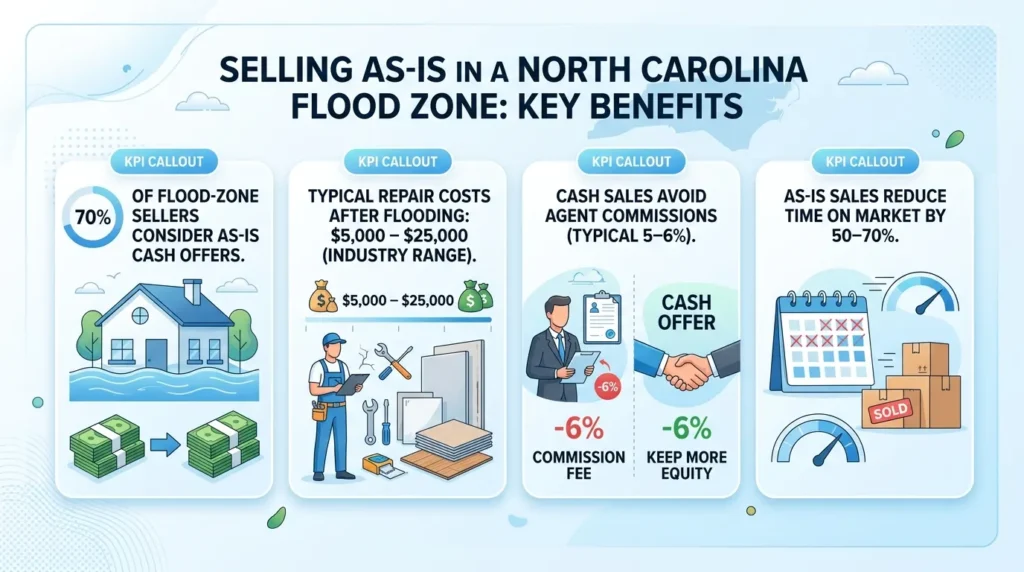
In some North Carolina flood-zone situations, selling as-is to a local cash buyer is the more practical move, even if a theoretical top-dollar MLS price sounds higher. Here are the situations where an as-is cash sale often shines:
- Repeated or severe flood damage. Traditional buyers, their inspectors, and their lenders are far more likely to walk or demand big credits.
- Premiums that shut financed buyers out. When flood insurance premiums are high enough to strain a financed buyer’s approval, your realistic buyer pool may shift toward cash anyway.
- Tight personal timelines. Foreclosure, divorce, job relocation, or an inherited property from out of state can make the traditional route impractical.
- Compounding problems. Flood damage plus a failed septic system or mold can make conventional financing much harder.
To protect yourself, ask any cash buyer for: proof of funds, local references, a clear contract without junk fees, and straightforward inspection terms.
See also ILM’s guides on selling a house with mold in NC, selling a house with pet damage in Wilmington, and how we buy houses.
Are You Actually Buying, Not Selling, in a Wilmington Flood Zone?
If you’re in buyer mode, your questions are about how much flood insurance might cost, how comfortable you are with the risk, and what your lender will require. That deserves its own deep dive with a good buyer’s agent who understands Wilmington’s floodplains. ILM focuses on buying directly from sellers, not acting as a buyer’s agent.
FAQ: NC Flood-Zone Sellers
Is Wilmington, NC in a flood zone?
Parts of Wilmington and New Hanover County are mapped in various FEMA flood zones, while others are not. Use the FEMA Flood Map Service Center or North Carolina’s flood risk portal to check your specific address.
Do I have to disclose that my house is in a flood zone in North Carolina?
Yes. In North Carolina, you’re expected to answer flood-related questions on the state disclosure form honestly, including known flood-zone status and known past flooding.
Can I sell without flood insurance?
Yes. Many financed buyers’ lenders will require them to obtain flood insurance if the home is in certain high-risk zones. A cash buyer generally has no lender requirement to carry flood insurance.
Does flood-zone designation automatically lower my property value?
Not automatically. It usually creates downward pressure compared to similar homes outside the lines, but buyers weigh the zone label, actual flood history, insurance cost, and neighborhood demand when settling on an offer.
Do I need an elevation certificate to sell my North Carolina flood-zone home?
In most cases, no. An elevation certificate is not legally required to sell, but it can help refine premium quotes and reassure some buyers. See FEMA’s elevation certificate guidance page.
Can I sell my Wilmington flood-zone house as-is to ILM Home Offer without doing repairs?
ILM Home Offer buys houses as-is in Wilmington, New Hanover County, and nearby coastal NC communities, including homes with storm or water damage. Needed repairs are factored into the offer.
Will high flood insurance premiums or recent flooding scare off a cash buyer?
Experienced local cash buyers like ILM look at these properties on purpose and price premiums and past floods into the offer from the start, rather than treating them as last-minute deal-killers.
What options do I have to sell quickly if my NC home is in a flood zone?
(1) Price aggressively on the MLS targeting cash buyers. (2) Sell directly to a local cash buyer like ILM Home Offer. (3) In limited qualifying situations, explore a government or hazard-mitigation buyout.
For sellers juggling flood-related septic issues, ILM also has a guide on selling a house with a failed septic system in NC.
Why a Cash Buyer Makes Selling a Flood-Zone Home Easier in Wilmington
A local cash buyer does not need lender approval and knows the older housing stock and storm history around Wilmington. We buy houses as-is and price the flood risk, repairs, and hassle into one number upfront.
ILM Home Offer buys houses as-is in Wilmington, New Hanover County, and nearby coastal North Carolina communities:
- No five-figure flood or mold repair project.
- No juggling contractors or mitigation work just to get listed.
- No waiting on lender underwriting or flood-insurance approvals.
- No repair negotiations after inspections.
- No agent commissions or seller-paid closing costs in our standard process.
If you’d like to talk through your specific flood situation and see what an as-is cash sale might look like, request an as-is cash offer from ILM Home Offer. Even if you end up deciding to list, having that number in your back pocket can make the rest of the choices a lot clearer.