
Opening a county envelope and seeing a much higher property value can feel overwhelming. The 2025 New Hanover County property revaluation resets your assessed value to match market reality as of January 1, 2025, but it doesn’t automatically change your tax bill, according to the county’s Real Property Revaluation page.
We’re local cash buyers in Wilmington and New Hanover County, so we track assessed values, tax bills, and appeal deadlines closely. If you’re staring at a much larger number than last cycle, take a breath — most owners have real, workable options once they understand how the pieces fit together.
This blog is in plain language for Wilmington homeowners, not tax professionals, and points to official county resources whenever numbers or deadlines matter. In it, we’ll cover:
• What the 2025 revaluation actually means for your property.
• How your new value could change your tax bill.
• How the county arrives at your number, and where it can miss the mark.
• Whether appealing, holding on, or selling makes the most sense for you.
What the 2025 Revaluation Actually Means
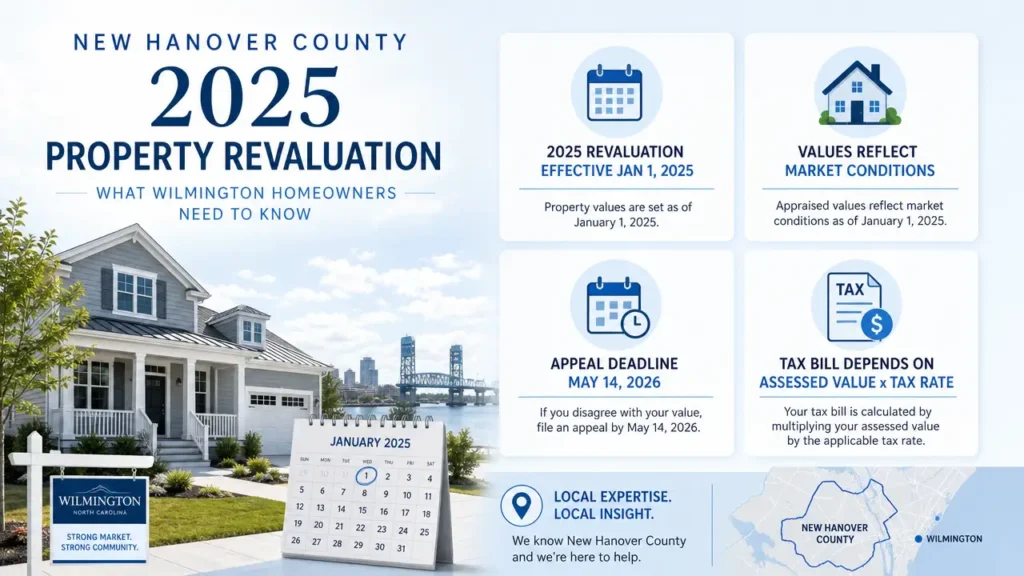
New Hanover County’s 2025 revaluation updates every property’s assessed value to match its estimated market value as of January 1, 2025. It is not a tax increase by itself, and it does not raise your bill by the same percentage as your new value. Your final property tax bill depends on both your new value and the tax rates local governments adopt afterward.
Three pieces make up your tax bill:
• Assessed value — the county’s estimate of your property’s worth.
• Tax rate — the combined rate from the county, city, and any special districts.
• Final bill — assessed value multiplied by the total tax rate, plus applicable fees.
Behind every value is the county’s Schedule of Values, the official framework appraisers use through January 1, 2029. It applies market data, neighborhood trends, and property characteristics to set values consistently across similar homes. For more on how property taxes work locally, see our guide to property taxes in Wilmington, NC.
This revaluation affects every property type across the county, including single-family homes, condos, and rental units. If you own property anywhere in New Hanover County, a new assessed value applies to you, regardless of how long you’ve owned the home. Your assessed value is part of a long-term, countywide system, not a personal judgment about your house.
The county doesn’t revalue on a whim; it follows this schedule so the tax base keeps pace with a market that has clearly moved since the last cycle. That’s the entire reason 2025 brought a new number for most Wilmington homeowners.
How Often Revaluation Happens and the 2025 Timeline
New Hanover County revalues property on a four-year cycle, with this cycle effective January 1, 2025 through January 1, 2029, per the county’s Revaluation FAQs. Notices go out after the county finishes its mass appraisal work for the effective date. From there, you have defined windows to question or formally appeal your value before it becomes final.
Here’s how the process typically unfolds:
1. Effective date (January 1, 2025) — values reflect market conditions as of this date.
2. Notices mailed — sent after appraisal work wraps up; check the county site for current dates, since these shift each cycle.
3. Informal review — ask questions or flag errors directly with county staff before filing anything formal.
4. Formal appeal (within 30 days) — file with the Board of Equalization & Review; one recent cycle listed May 14, 2026 as the deadline, per FAQ QID 827.
5. BOER hearing window — appeals are scheduled and heard, which can take time during a busy revaluation year.
6. New values apply — once appeals resolve or deadlines pass, updated values and rates generate your bill.
Rising values often reflect real appreciation that already happened in the local market. For context on recent price trends behind this cycle, see our Wilmington real estate market trends breakdown.
Exact mailing dates, hearing schedules, and appeal deadlines shift with every cycle, so always confirm current dates directly on the county’s official pages rather than relying on a prior year’s calendar.
How Your New Value Could Affect Your Tax Bill
A higher assessed value can raise your bill, but the size of the increase depends on the total tax rate applied, not the value alone. Both the county and City of Wilmington set rates through separate budget processes, and rates sometimes adjust downward in revaluation years to offset rising values. Check the official Tax Department page for current rates before assuming the worst.
Here’s a simplified example using hypothetical numbers, not official rates:
| Scenario | Assessed Value | Tax Rate | Annual Bill |
| Before revaluation | $300,000 | 0.90% | $2,700 |
| After (rate unchanged) | $390,000 | 0.90% | $3,510 |
| After (rate adjusted down) | $390,000 | 0.75% | $2,925 |
Your actual numbers depend on where in the county you live and what rates local officials ultimately adopt. Track your real bill and payment status through the county’s eTax portal rather than relying on estimates. For some owners, especially retirees on fixed incomes or landlords with thin margins, a higher annual bill can tip a property from manageable to genuinely stressful.
Gaining paper equity doesn’t help much if it costs you sleep and cash every single month. That tension is exactly why some owners start weighing an appeal against selling altogether once they see their new number.
If you’re unsure whether your budget can absorb a higher bill, run your own numbers using the formula above before assuming the worst. A clear picture beats guessing, and it’s the first step toward deciding your next move.
How the County Determines Your New Value
New Hanover County uses mass appraisal, a system that values thousands of properties at once using recent sales, neighborhood trends, and basic property characteristics. It is a model-driven process, not a room-by-room custom appraisal. The Real Property Revaluation process and Schedule of Values guide how appraisers group and value homes across the county.
Data the county typically relies on includes:
• Recent comparable sales in your neighborhood or market area.
• Square footage, year built, construction type, and land size.
• Neighborhood-level market trends across Wilmington and New Hanover County.
• Recorded permits and improvements for additions or renovations.
What the county often misses:
• Interior condition issues like old roofs, outdated systems, mold, or soft floors.
• Storm or flood damage that never went through permitting.
• Deferred maintenance or unpermitted work that isn’t in county records.
Because mass appraisal relies on data and averages rather than a walkthrough, some homes end up overvalued while others come in low. If your home has real, documentable condition problems, that gap is often worth raising in an appeal.
Common reasons a value feels too high locally include:
• Fast neighborhood appreciation, where the comparable sales set reflects nearby homes that are more updated than yours.
• County records showing more finished square footage than the home actually has.
• Storm or flood damage from a coastal event that isn’t obvious from the street or from permits on file.
A computer model can’t smell mold or feel a soft floor. It only reflects the data it was given, which is exactly why documented condition issues carry real weight in an appeal.
Reviewing Your Value: A Quick Appeal Checklist
Before filing an appeal, confirm whether your value is truly out of line with the market rather than just higher than you expected. A methodical review saves time and strengthens your case if you do decide to appeal.
Follow these steps:
1. Read your notice for the assessed value, parcel ID, and land-versus-building breakdown, since these are the numbers any appeal will reference.
2. Pull your full property record online and check square footage, bed and bath count, and listed improvements for errors that could be inflating your value.
3. Run the county’s Comparable Sales Search for homes similar in location, size, age, and condition.
4. Compare price per square foot between your assessment and those recent comparable sales.
5. Gather real evidence — photos, contractor estimates, appraisals, or MLS data. The county’s Revaluation FAQs and Property Value Appeals pages outline useful documentation types.
6. Weigh the likely savings against the effort before deciding whether filing is worth your time.
If this process makes you question whether keeping the property still makes sense, you’re not alone. Many owners end up comparing an appeal against simply selling and moving their equity elsewhere.
Appealing is about showing where the county’s data or comparison set is off, not arguing that taxes in general feel too high. Strong evidence, not frustration, is what actually moves a reviewer.
Your Appeal Options: Informal Review to State Level
New Hanover County offers a defined, normal appeal path, and using it doesn’t penalize you in any way. It’s simply how you ask the county to correct a value that’s higher than market or inconsistent with similar properties.
| Stage | What Happens | Where to Start |
| Informal review | Share your notice and evidence with county staff directly | Property Value Appeals, 910-798-7300 |
| Formal appeal (BOER) | File within 30 days of your notice; attend a hearing if scheduled | Residential Property Tax Appeal |
| State-level appeal | Escalate further to the NC Property Tax Commission if needed | Property Tax Appeal Process |
Arguments tied to market value and fairness tend to succeed, such as showing comparable sales below your assessment or documenting unrecognized damage. General frustration about taxes, or comparisons to a neighbor’s bill, rarely moves the needle. Appeals can take real time to schedule and conclude, so starting early matters, especially for landlords managing multiple properties at once.
For landlords and investors with several units in Wilmington, appeal timelines matter even more. If a big tax jump turns a building from break-even to negative cash flow, running the appeal path while also pricing out a sale can be a smart parallel move.
Most straightforward errors, like wrong square footage or an obvious condition gap, get resolved at the informal stage without ever reaching a formal hearing. Save the formal appeal for cases where the informal conversation doesn’t resolve things.
• If your case does reach a formal hearing, bring printed comparable sales, dated photos, and any contractor estimates. Keep a copy of everything you submit for your own records.
• Our where we buy houses page covers the Wilmington and New Hanover County areas we serve if selling ends up part of your plan.
Appeal or Sell? Weighing Your Options
Appealing can lower a number on paper, but it doesn’t fix an aging roof, a barely-profitable rental, or an inherited property nobody nearby wants to manage. Selling resets the situation entirely, though it carries its own tradeoffs to weigh honestly. Neither choice is automatically right for every owner facing a higher notice.
| Factor | Appealing | Selling |
| Upfront cost | Mostly time and paperwork | Depends on the sale method and terms |
| Likely outcome | May lower your bill if the value is truly too high | Removes future tax and maintenance responsibility entirely |
| Fixes underlying issues (repairs, tenants, distance) | No | Yes |
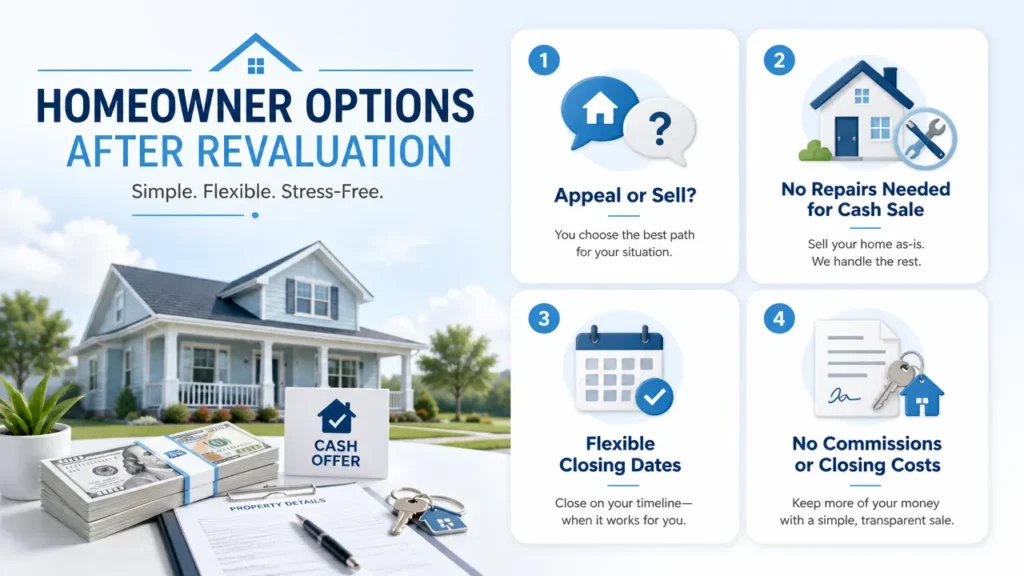
A local cash buyer like ILM Home Offer buys homes as-is, in any condition, with no repairs required, no commissions, and no closing costs for the seller. You also choose your own closing date. We factor current tax conditions directly into every offer we make, so there’s no surprise later.
Selling tends to make the most sense in a few common situations:
• Tired landlords whose rentals just flipped from break-even to negative after the new bill.
• Inherited or out-of-state properties nobody nearby wants to manage or repair.
• Storm-damaged or older homes where the true condition cost outweighs any appeal savings.
None of these scenarios mean an appeal is a bad idea. They simply mean an appeal alone may not solve the bigger problem, which is often distance, burnout, or a property that no longer fits your life.
When we evaluate a storm-damaged or dated Wilmington property, we price the real condition and the current tax picture into the offer upfront. That way, the number you see reflects reality rather than requiring repairs first.
• See our breakdown of the cost of selling a house in NC to compare one-time selling costs against years of higher taxes.
• Check what an as-is cash offer might look like on our get a cash offer today page whenever you’re ready.
Whether you appeal, hold on, or sell, the goal is the same: make a decision based on real numbers instead of a stressful notice sitting on the counter. The FAQ below covers the questions Wilmington homeowners ask most often about this cycle.
FAQ: New Hanover County Property Revaluation
When is the current revaluation effective?
The current New Hanover County revaluation is effective January 1, 2025, per the Real Property Revaluation page, reflecting market conditions as of that specific date rather than today’s market.
Does a higher value mean a higher tax bill?
Not automatically. Your bill depends on the assessed value multiplied by the adopted tax rate, which can rise, fall, or hold steady after budget season. Track actual charges on the eTax portal.
How do I appeal my new value?
Start with an informal review with county staff, then file a formal appeal with the Board of Equalization & Review within 30 days, per the Residential Property Tax Appeal page.
What’s the difference between assessed value and my tax bill?
Assessed value is the county’s market estimate for your property as of the effective date. Your bill is that value multiplied by the combined tax rate, per the Tax Department.
Can I sell my house as-is during an appeal?
Yes. You can sell your property anytime, even in the middle of an appeal. A cash buyer like ILM Home Offer buys as-is and factors current taxes directly into the offer amount.
Will a higher tax bill scare off a cash buyer?
No. Legitimate cash buyers expect tax changes after every revaluation cycle and build those annual costs into their offer calculations from the start, rather than treating them as a dealbreaker.
When should I contact ILM Home Offer?
Reach out as soon as a new notice makes you question whether keeping the property still fits your budget or plans. See our get a cash offer today page.