


Picture yourself at your kitchen table in Leland or Shallotte, staring at a tax bill higher than last year’s. Maybe your mortgage escrow just jumped. Or maybe your rental that used to cash flow now barely breaks even.
Here is Brunswick County property taxes explained in plain English. The county multiplies your assessed value by the combined rate for your county, town, and districts. Understand those two pieces, and the next bill won’t blindside you.
This guide walks through how the bill is built, what relief exists, and how taxes shape selling decisions. It’s written for local homeowners, landlords, and Wilmington owners holding Brunswick County property.
In it, you’ll learn:
- How county, town, and district rates stack into one combined rate.
- Why assessed value can differ from market value, and how to appeal.
- How to estimate your yearly and monthly property tax bill.
- Which North Carolina relief programs exist, and why investors rarely qualify.
Brunswick County Property Taxes Explained in Plain English
Brunswick County property taxes are local taxes based on your property’s assessed value. The county collects them, often alongside town taxes, to fund everyday public services. Those services include schools, sheriff and police, EMS, and roads. Bills typically arrive once a year by late summer.
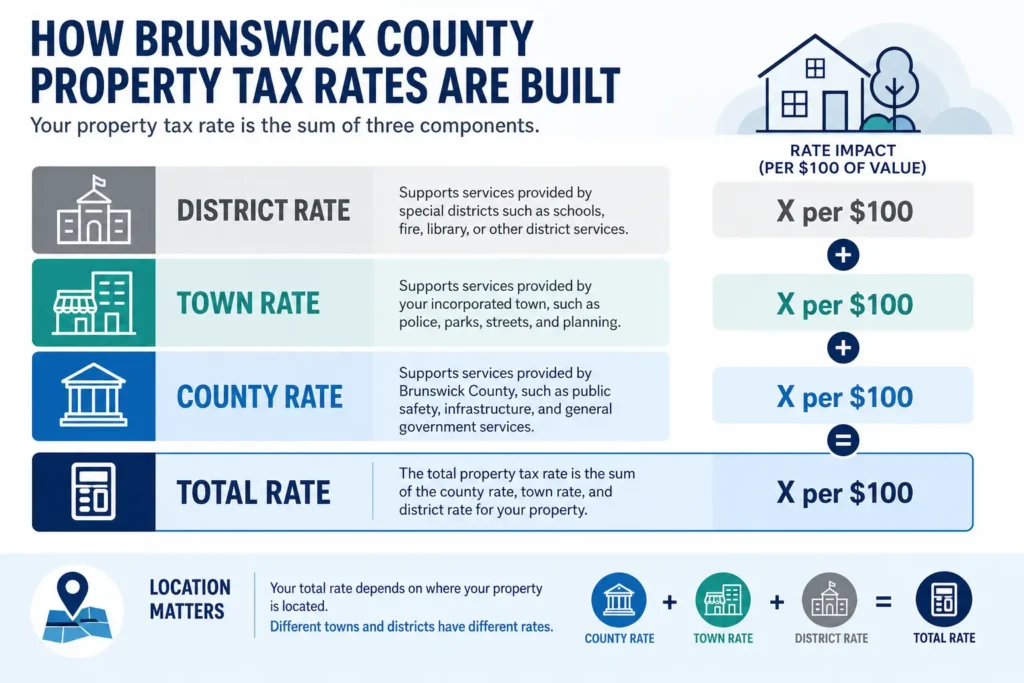
If you own in Leland, Shallotte, Oak Island, or Southport, your bill usually has several layers:
- County rate: Applies to every taxable property in Brunswick County.
- Town rate: Applies only if your property sits inside municipal limits.
- Special districts and fees: Some areas carry district taxes, and most bills include a fire fee.
Many Wilmington-area residents own beach houses or rentals across the river in Brunswick County. They live in New Hanover County but still pay Brunswick County taxes every year. Our guide to Pender County property taxes explained covers a similar system just north of Wilmington.
For tight budgets, the tax bill is a fixed cost that doesn’t care about late rent. Missed bills start collecting interest after the January deadline. The Brunswick County Collections Division can pursue garnishment, bank attachment, or foreclosure on unpaid accounts.
Signs that property taxes are squeezing your budget include:
- Your escrow shortage notice raised your monthly mortgage payment.
- Your rental’s rent no longer covers taxes, insurance, and repairs.
- You’re dipping into savings or credit cards to pay the yearly bill.
How Brunswick County Property Tax Rates Work (County, Town, and Districts)
Picture a landlord with one rental outside Leland and another inside town limits. The houses look alike, yet the tax bills differ noticeably. The reason is the stack of rates tied to each property’s exact location.
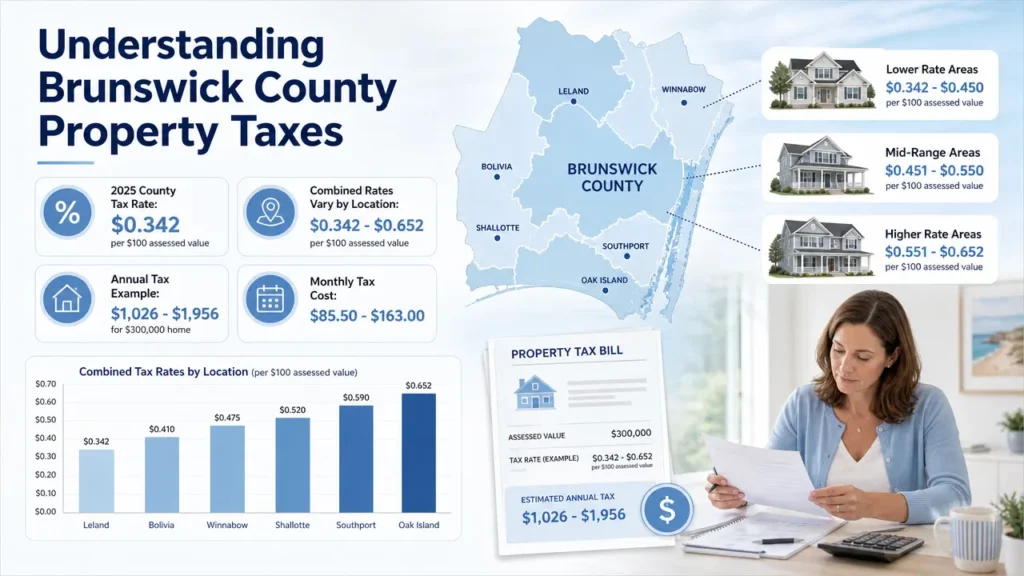
Brunswick County sets a countywide rate per $100 of assessed value. The Brunswick County Tax Office rate table lists the 2025 county rate at $0.342 per $100. Towns like Leland, Oak Island, and Southport add their own rates on top.
| Location Type | What Appears on Your Bill | 2025 Combined Rate Example |
| Unincorporated Brunswick County | County rate plus applicable fees | $0.342 per $100 |
| Inside Oak Island | County rate, town rate, plus applicable fees | $0.542 per $100 |
| Inside Leland | County rate, town rate, plus applicable fees | $0.612 per $100 |
| Inside Southport | County rate, town rate, plus applicable fees | $0.652 per $100 |
Fire protection works differently here than in many counties. According to WECT, Brunswick County funds fire service through fees rather than a fire tax. Several departments raised those fees on 2026 bills. Questions about those fees go to your fire department, not the Tax Office.
Your combined rate can change from year to year for several reasons:
- County commissioners and town councils adopt new rates during annual budgets, usually in late spring or early summer.
- A town may raise, lower, or hold its rate based on local needs like schools or infrastructure.
- Fire departments can adjust fees within caps set by state law.
Always confirm the current rate for your address instead of trusting a neighbor’s bill. Two streets over, the total can look very different. Special districts, like Smithville Township or Bald Head Island service zones, add their own small rates.
Assessed Value vs. Market Value in Brunswick County
Imagine a retired couple in Shallotte who haven’t changed anything about their home in years. Then a new assessment notice arrives, and the value looks shockingly high. Your Brunswick County tax bill is based on assessed value, not tomorrow’s sale price. That gap explains most surprise notices.
- Assessed value: The figure the county assigns for tax purposes, updated mainly during countywide revaluations.
- Market value: Roughly what a willing buyer would pay today, based on comparable sales, condition, and location.
- Between revaluations: New construction, additions, or a change in use can prompt the county to update a value.
North Carolina requires counties to revalue property at least every eight years. The Brunswick County Tax Office confirms the most recent revaluation took effect January 1, 2023. The next countywide revaluation is scheduled for January 1, 2027. Owners should expect new value notices early that year.
In fast-growing areas like Leland, Supply, and Calabash, market values often outpace the tax roll. A revaluation then pulls assessed values closer to current sales. Higher values don’t always mean higher bills, because rates may be adjusted afterward. After the 2023 revaluation, the county rate fell from $0.485 to $0.342.
Neighbors in New Hanover faced similar questions, as our New Hanover County property revaluation guide explains.
If you think your new value is wrong, take these steps:
- Compare your value with recent sales of similar nearby homes.
- Gather photos or repair estimates showing condition issues the county can’t see from the street.
- Request an informal review with the Tax Office before the deadline on your notice.
- Remember that your ability to pay the tax isn’t a valid reason to appeal.
- If unresolved, appeal to the Board of Equalization and Review, then the NC Property Tax Commission.
Step-by-Step: Estimating Your Brunswick County Tax Bill
Now picture a small landlord in Bolivia, yellow pad out, testing whether a rental truly cash flows. The basic formula is simple: assessed value ÷ 100 × your combined rate. Your combined rate is the county, town, and district stack covered earlier.
- Find your assessed value on your latest tax bill or assessment notice.
- Add up your rates: county, town if applicable, and any special district.
- Apply the formula: divide the value by 100, then multiply by the combined rate.
- Subtract any relief you qualify for on a primary residence.
- Divide by 12 to compare the tax with rent, mortgage, and insurance.
Here’s how a home assessed at $300,000 compares across locations using 2025 rates:
| Location | Combined Rate (2025) | Annual Tax | Monthly Cost |
| Unincorporated county | $0.34 | $1,026 | $85.50 |
| Oak Island | $0.54 | $1,626 | $135.50 |
| Leland | $0.61 | $1,836 | $153.00 |
| Southport | $0.65 | $1,956 | $163.00 |
These figures exclude fire fees and assume 2025 rates, so check your current bill. Your actual bill may also include town fees. The same house can cost about $930 more per year depending on location.
With a mortgage, your lender likely escrows taxes and pays the county for you. When taxes rise, your escrow adjusts and your monthly payment climbs. Expect a new escrow analysis after each tax change. If you own the home free and clear, you must set that money aside yourself.
Property changes, like adding a garage or finishing a bonus room, can raise your assessed value. For struggling owners, this math matters as much as the sale price. Holding another year can cost more in taxes and insurance than a higher price returns.
Tax Relief and Exemptions in Brunswick County (and What Investors Can’t Use)
Picture a widowed homeowner in Southport who hears about a senior tax break from a neighbor. She worries she already missed the window. Missing June 1 doesn’t always end your chances, so ask the Tax Office. North Carolina offers relief, but programs target primary-residence owners, not investors.
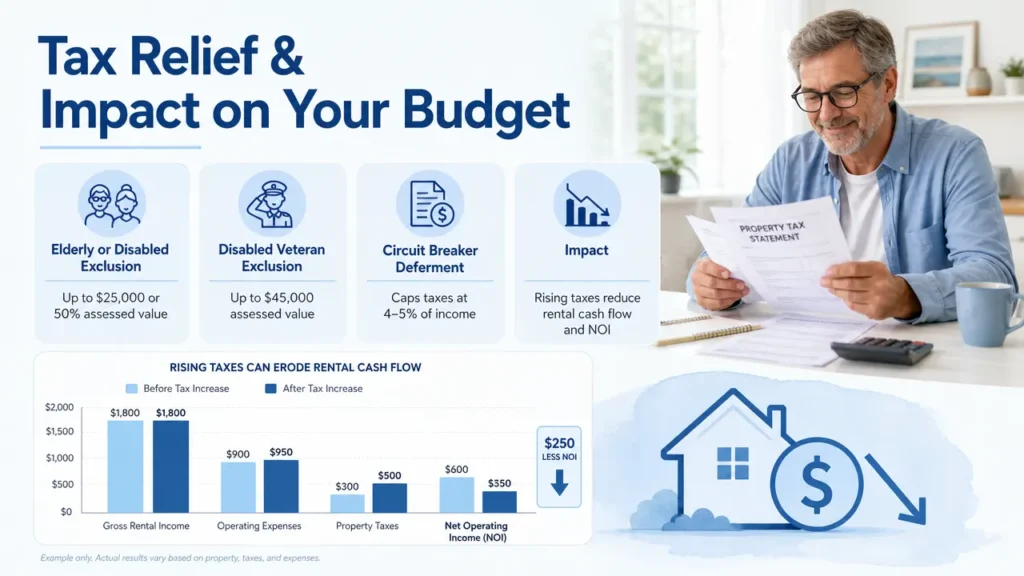
All three state programs use one form, the NCDOR AV-9 Application for Property Tax Relief. Applications are generally due by June 1 for that tax year. Here’s how the programs compare for 2026:
| Program | Who Qualifies | 2026 Income Limit | Benefit |
| Elderly or Disabled Exclusion | Age 65+ or totally and permanently disabled | $38,800 | Excludes the greater of $25,000 or 50% of assessed value |
| Disabled Veteran Exclusion | Veterans with a 100% service-connected disability, or certain surviving spouses | No income limit | Excludes up to $45,000 of assessed value |
| Circuit Breaker Deferment | Age 65+ or totally and permanently disabled | $58,200 | Caps taxes at 4% or 5% of income; the rest is deferred |
What trips people up is that relief follows the owner’s primary residence, not the property itself.
Here’s a common Leland scenario:
- You buy a home, live in it, and qualify for the Elderly or Disabled Exclusion.
- Later, you move to Wilmington and rent out the Leland house.
- Once it’s no longer your primary residence, the exclusion ends.
There’s no special investor exemption for owning many rentals or holding them in an LLC. Investors should underwrite deals assuming full property taxes. Treat any legitimate relief as a bonus only after the county confirms it. Circuit breaker deferrals can also come due when the home is sold.
If you think you qualify on your primary home, here’s how to apply:
- Download Form AV-9 from NCDOR or request it from the Brunswick County Tax Office.
- Attach proof of income and, if under 65, a disability certification.
- Submit everything by June 1 and keep copies for your records.
- Check your next tax bill to confirm the relief appears.
What Brunswick County Property Taxes Do to Your Cash Flow and Sale Options
Picture an owner whose small rental cash flowed two years ago. After rising taxes and insurance, they now cover shortfalls from their paycheck. Property taxes are an operating expense, so every increase cuts directly into returns.
On a rental, the basic math works like this:
- Rent comes in each month.
- Subtract taxes, insurance, maintenance, management, and owner-paid utilities.
- What remains before debt service is your Net Operating Income (NOI).
- Rising taxes without rising rent shrink NOI dollar for dollar.
Taxes rarely rise alone along the coast. Premiums often climb too, as our guide to hurricane insurance costs in coastal North Carolina explains. Together, they can push a Navassa or Boiling Spring Lakes rental toward negative cash flow.
Flippers face a similar squeeze. Every extra month of holding time adds interest, utilities, and prorated taxes. A delayed project may even carry into another full tax cycle. Build that cost into your purchase price from day one.
Watch these specific tax risks in a growing county:
- 2027 revaluation: Updated assessments could shift values across the county.
- Town rate changes: Councils can raise or lower rates during each budget cycle.
- Fee increases: Fire departments raised fees on many 2026 bills.
Smart investors stress-test deals by assuming higher taxes than last year’s bill. If a property only works when everything goes perfectly, it may not be strong. For tired landlords, a fair as-is offer can beat another year of feeding the property. Walking away clean can be worth more than one more year of ownership on paper.
Where to Look Up Your Brunswick County Tax Bill and Get Real Answers
Picture yourself staring at an unfamiliar fee line, wondering if the amount is even right. The clearest answers come from the county’s official tools and offices. Start with the Property and Tax Information search on the Tax Office website. It typically shows current and past bills, payments, and charge breakdowns.
Bills are due September 1, and you can pay without interest through January 5. After that, 2% interest applies, plus 0.75% each additional month. Payment arrangements are available through the Collections Division. Under state law, not receiving a bill doesn’t cancel the tax or interest.
| Your Question | Who to Contact |
| County taxes, bills, and payment plans | Brunswick County Tax Office and Collections Division |
| Assessed value or appeals | Brunswick County Tax Office assessment staff |
| Town tax rates | Your town or city finance office |
| Fire fee amounts | The fire department serving your property |
Before you call, gather these items:
- Your parcel ID or account number from an old bill.
- Recent sales of similar homes if you’re questioning value.
- Photos, appraisals, or repair estimates showing condition problems.
- A short list of questions, so the call stays focused.
Only the county can give the final word on your specific bill. Once you know exactly what you owe, you can decide whether to keep, rent, or sell. Families settling an estate should also review heir property in North Carolina before selling.
If repairs and taxes both feel overwhelming, see how to sell when your house needs repairs you can’t afford. A local cash buyer can close on your timeline and handle tax payoffs at closing. There are no commissions, no repair negotiations, and no lender delays.
If you own in Leland, Shallotte, Southport, Navassa, or nearby, compare your numbers against a no-pressure as-is offer. From there, decide what feels better for your budget and your peace of mind.
FAQs: Brunswick County Property Taxes
Who collects Brunswick County property taxes?
The Brunswick County Tax Office collects county taxes and, for many towns like Leland and Southport, municipal taxes too. Those taxes fund schools, public safety, roads, and other local infrastructure across the county.
What is the difference between assessed value and market value?
Assessed value is the figure the county uses to calculate your tax bill. Market value is what a buyer would pay today. They move closer together after each revaluation, with the next effective January 1, 2027.
When are Brunswick County property taxes due?
Bills are due September 1, and you can pay without interest through January 5. After that, the county adds 2% interest, then 0.75% for each additional month the bill stays unpaid.
Are there investor-specific property tax exemptions in Brunswick County?
No. North Carolina’s relief programs serve qualifying elderly, disabled, and disabled veteran homeowners on their primary residence. Landlords, flippers, and second-home owners should assume they’ll pay full property taxes on every property.
Can I sell my Brunswick County house if I’m behind on property taxes?
Usually, yes. Back taxes, interest, and any liens are typically paid from sale proceeds at closing. A closing attorney confirms the payoff with the county and explains what must be cleared before the property transfers.
Will high taxes or a recent reassessment scare off a cash buyer?
Not usually. Experienced local cash buyers review current tax bills and carrying costs when making offers. A reassessment may affect the numbers, but it rarely stops a cash sale from making sense for the seller.