

Losing a parent is hard enough without a house full of question marks. If several siblings or cousins now share a family home and no one is sure who can legally sell it, you may be dealing with heir property. In plain English, heir property in North Carolina happens when multiple heirs own a property together, usually after someone dies without a clear will or full probate.
That shared ownership makes selling, refinancing, or even insuring the house trickier than a typical inherited sale, and it can catch families completely off guard at the worst possible time. This blog will tell you what heir property is, the real risks families face, and the realistic paths to selling in Wilmington and coastal North Carolina, including working with a local cash buyer, without handing out legal advice.
What Is Heir Property in North Carolina?
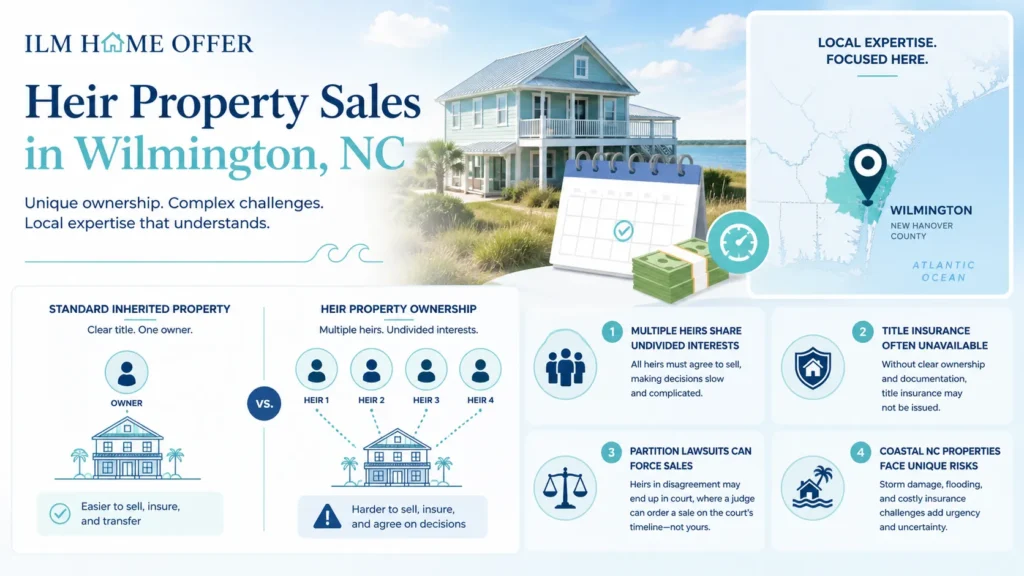
Heir property is land owned by multiple family members as undivided interests after an owner dies without a will, or when the estate is never taken through probate. According to NC State Extension’s heirs’ property guide, that gap leaves title unclear and the property vulnerable to loss across every county in the state. Practically speaking, no single heir can prove they alone own the house, and a bank or title company usually can’t insure a sale. This is different from a simple inherited property, where one clear owner is on the deed and free to sell whenever they choose.
We see this a lot with families here on the coast. A rental in Carolina Beach might get left to four cousins after Grandpa passes, or a small parcel in Pender County stays in one name for thirty years while several generations quietly share it. Most families don’t hear the term “heirs’ property” until they try to sell, refinance, or apply for storm repair help and get told the title is clouded. By then, the confusion has usually been building for years, sometimes stretching back two or three generations before anyone tries to untangle it.
| Standard Inherited Property | Heir Property | |
| Ownership | One heir clearly on the deed | Multiple heirs share undivided interests |
| Selling | Can list or sell right away | Needs all owners’ signatures first |
| Financing | Usually qualifies for typical loans | Often ineligible until title is cleared |
| Insurance & aid | Usually straightforward | FEMA and lenders may require clear title |
Not sure who’s actually on the deed versus who legally owns the property today? Our deed vs. title guide breaks down that exact confusion, which trips up a lot of heir property families before they even get to a closing table.
How NC Heir Property and Intestate Succession Actually Work
When someone dies in North Carolina without a will, North Carolina’s intestate succession law decides who inherits. Multiple heirs often end up owning the home together as tenants in common, meaning nobody owns a specific room or corner of the yard. Instead, each heir owns a fractional slice of the whole property, whether that’s a spouse, children, or more distant relatives. Probate is the court process meant to move the property out of the deceased person’s name, and skipping it lets the deed sit untouched for years.
That’s usually when heir property forms. We talk with families where one heir lives in the house, one is in Raleigh, and one has been gone for a decade with no forwarding address. Every one of them may still hold a legal claim, even without paying a dime of taxes toward the property or ever stepping foot on it. Let’s break this down step by step, starting with who the law actually recognizes as an heir in the first place.
| If the person who died was survived by… | …here’s who generally inherits |
| A spouse and two or more children | Spouse gets part of the personal property and one-third of real estate; children split the rest |
| A spouse and parents, no children | Spouse and parent(s) split personal property and real estate |
| A spouse only | Spouse inherits everything |
| Children only | Children split everything evenly |
| No spouse, children, or parents | More distant relatives inherit, in the order set by law |
This isn’t legal advice, and every family’s situation looks a little different once half-siblings, adopted children, or out-of-state relatives enter the picture. Common seller questions we hear include:
• Who actually has to sign to sell the house?
• What happens if an heir moved out of state and lost touch with the family?
• What if someone on the old deed has since passed away too?
• Does it matter if some heirs never lived in North Carolina?
Common Problems and Risks With Heir Property in North Carolina
Shared ownership sounds simple until real life gets involved. One heir may live in the Wilmington house rent-free while siblings in other states keep covering the taxes. Cousins can spend years arguing over a Carolina Beach rental instead of agreeing on a plan. Meanwhile, unpaid taxes, code violations, and storm damage can quietly pile up while everyone waits for someone else to act first, and resentment tends to build right alongside the bills.
• Years of disagreement over whether to keep, rent, or sell the property
• Nobody wanting to cover taxes, insurance, or overdue repairs
• Delinquent tax bills that risk a forced tax sale down the road
• Trouble getting homeowner’s insurance or disaster relief after a hurricane
• A partition lawsuit, from an heir or an outside buyer, that forces a sale on a timeline the family didn’t choose
Selling with a long repair list and murky ownership can eat into what you actually walk away with. Our breakdown of the cost of selling a house in NC shows how commissions, repairs, and months on the market add up faster than most sellers expect. For families stuck in this cycle, a straightforward as-is cash sale is often easier to agree on than a traditional listing, since there’s one number instead of a long repair negotiation.
Partition Actions: How Heir Property Can Be Sold Without Full Agreement
A partition action is a lawsuit where one co-owner asks the court to divide or sell the shared property. Under North Carolina’s partition law, the court can order “partition in kind,” physically splitting the land, or “partition by sale,” selling it and dividing the proceeds among the heirs. For a single-family home in Wilmington, partition by sale is almost always the outcome, since a house can’t be cut in half. If you receive court papers mentioning partition, talk with an NC attorney right away rather than waiting to see what happens.
1. An heir, or someone who bought an heir’s share, files the partition petition with the court.
2. The court notifies every other heir, including any who are hard to locate.
3. The court decides whether the property can be divided or must be sold.
4. If it’s sold, proceeds are split among heirs based on their ownership share.
Sometimes an outside investor buys one frustrated heir’s interest cheap, then files for partition to force a sale on their own timeline. Other times, one heir simply uses it to break a years-long family stalemate. Either way, once the case is filed, it’s a court, not the family, controlling how and when the property gets sold, and the process can move faster than most families expect once it starts.
Can Heir Property Be Sold in NC, and What Do You Need to Get There?
Yes, heir property can usually be sold in North Carolina, but only once ownership is clear enough for a closing attorney to insure the title. In most cases, every owner of record has to sign the closing documents before a sale can go through, a point confirmed by the NC Department of Justice’s heirs’ property resources. During a title search, the attorney and title company look for old deeds, death certificates, probate records, and any missing or unknown heirs. Even a cooperative family can need weeks or months to gather everything before closing day, especially if records are scattered across different counties.
| Document | Why it matters |
| Recorded deed(s) | Shows the last confirmed chain of ownership |
| Death certificates | Confirms which owners have passed away |
| Probate records | Shows how, or whether, an estate was settled |
| Affidavit of heirship | Helps identify heirs when probate was skipped |
• Certified copies often come from the county register of deeds or clerk of court, which can add time to the process.
• Old liens from medical bills or judgments can surface during the search and need to be cleared before closing.
Chasing the highest possible price with a traditional listing doesn’t always leave more in your pocket once repairs, commissions, and carrying costs are counted. Our guide to closing costs for sellers in NC walks through what a standard sale actually costs from contract to closing. A fair as-is cash offer can net out similar, or better, once everything is added up honestly, especially once you factor in months of extra taxes and upkeep while title gets sorted out.
Steps to Resolve Heir Property and Get Ready to Sell
Clearing up heir property doesn’t start with a lawyer; it starts with paperwork you probably already have sitting in a drawer somewhere. Here’s the order that tends to work best for families we’ve talked with around Wilmington and the beaches, based on what usually speeds things up and what tends to slow them down.
1. Gather what you have: old deeds, tax bills, insurance papers, wills, and death certificates.
2. Sketch a simple family tree showing who has passed and who might be an heir.
3. List every family member who could have a claim, including those out of state.
4. Contact an NC probate or real estate attorney, or Legal Aid of NC if you qualify.
5. Follow their guidance on probate, affidavits, or other steps needed to clear title.
6. In coastal NC, get a read on storm damage, flood history, or code issues that affect value.
Reaching out to a local cash buyer while your attorney works can help set realistic expectations on as-is value and timing, without committing to anything. Don’t ignore court letters or tax notices while this is underway; they rarely resolve themselves on their own.
Heir Property in Wilmington and Coastal North Carolina: Local Nuances
Coastal NC heirs deal with more than legal tangles. Hurricane damage, high insurance costs, and mold in older homes are common realities around Wilmington and the beaches. A 1950s bungalow near downtown Wilmington might carry storm repairs from three different seasons, and a Carolina Beach cottage might have old flood claims attached to it. Lenders and traditional buyers can get skittish about storm-damaged or flood-prone homes, especially when the title is messy too, and that combination can leave a property sitting for months without a serious offer.
• Repair-assistance and disaster-relief programs often require clear title before they’ll help a family
• Standard insurers may hesitate on older roofs, past flood claims, or long-vacant homes
• Multiple owners make it harder to agree on who pays for storm repairs
• Salt air and humidity add wear that inland properties simply don’t deal with
None of that means the house is unsellable. It just means the path usually runs through a buyer who already understands coastal property and doesn’t need a bank’s approval to close, which matters when title, repairs, and storm history are all stacked up together.
Why a Cash Buyer Makes NC Heir Property Easier to Sell
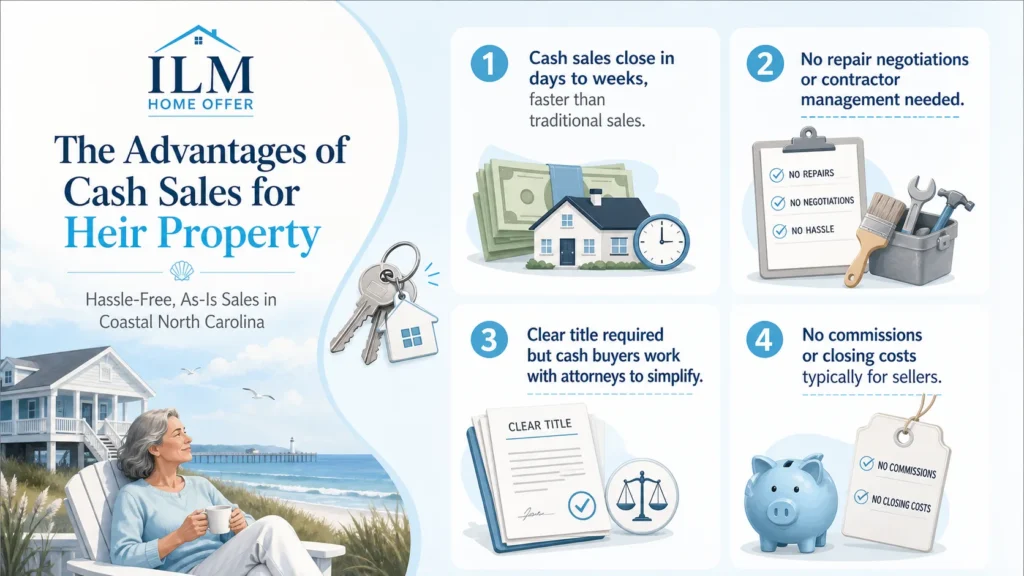
Once your attorney has mapped out who legally owns the property, a cash buyer can move without waiting on a lender’s underwriting. We’re familiar with Wilmington’s older housing stock, hurricane repairs, and flood history around here, and we buy as-is, so a five-figure repair list doesn’t have to happen before closing. We’ve worked alongside NC attorneys and title companies for years, letting them handle probate and signatures while we handle the number and the timeline for the family. In plain English, that means fewer moving parts for everyone already juggling grief, paperwork, and a family full of opinions.
If your family is untangling heir property in Wilmington or nearby coastal NC, reach out once you have a sense of where things stand. Call (910) 742-0414 or request a no-pressure cash offer: no repairs, no lender approval, no repair negotiations, no commissions, and typically no closing costs on your end.
FAQs: Heir Property North Carolina
Can heir property be sold in North Carolina?
Yes. All owners of record generally must sign for a closing attorney to transfer clear title. The exact steps depend on your heirs and any missing probate work, so it’s worth confirming details with an NC attorney early on.
What documents help clear title on NC heir property?
Recorded deeds, death certificates, and probate records are the core documents families need. They help a closing attorney build a clear chain of ownership and confirm exactly who legally needs to sign before a sale can close.
What is a partition action?
It’s a lawsuit where a co-owner asks a court to divide or sell shared property. For most homes, courts order a sale and split the proceeds among heirs, sometimes without full family agreement on the timing.
Do I need to repair the house before selling to a cash buyer?
No. Cash buyers like ILM Home Offer purchase as-is, including storm damage or years of deferred maintenance. Serious safety issues may still need disclosure, but you won’t need to manage contractors or repair crews first.
Can a cash buyer close if lenders or insurers are hesitant about the house?
Often, yes. Without bank financing involved, condition concerns that worry lenders, like old roofs or flood history, matter less once an attorney confirms a clear path to title for everyone involved.
How long does selling heir property take with a cash buyer?
Legal and title work is usually the longest part of the process. Once an attorney confirms the path is clear, a cash sale can often close in days to a few weeks, with no appraisal or repair negotiations.