


Picture yourself at the kitchen table in Jacksonville or Swansboro, holding a tax bill that jumped from last year. You wonder how the county reached that number. You also wonder what happens if you cannot keep up.
Onslow County property taxes start with a base county rate per $100 of assessed value. Extra layers come from your city, town, fire district, or special district. If the total is squeezing your budget, you still have real options.
This guide explains Onslow County property taxes in plain English. It covers rates, bill math, revaluation, relief programs, appeals, and what happens when taxes go unpaid. It also explains when selling might take the pressure off.
Onslow County property taxes 101: rates, add-ons, and why neighbors pay different amounts
Picture you and a Jacksonville neighbor comparing tax bills side by side. The homes look similar from the street, yet the totals differ. The explanation usually comes down to location and layered rates.
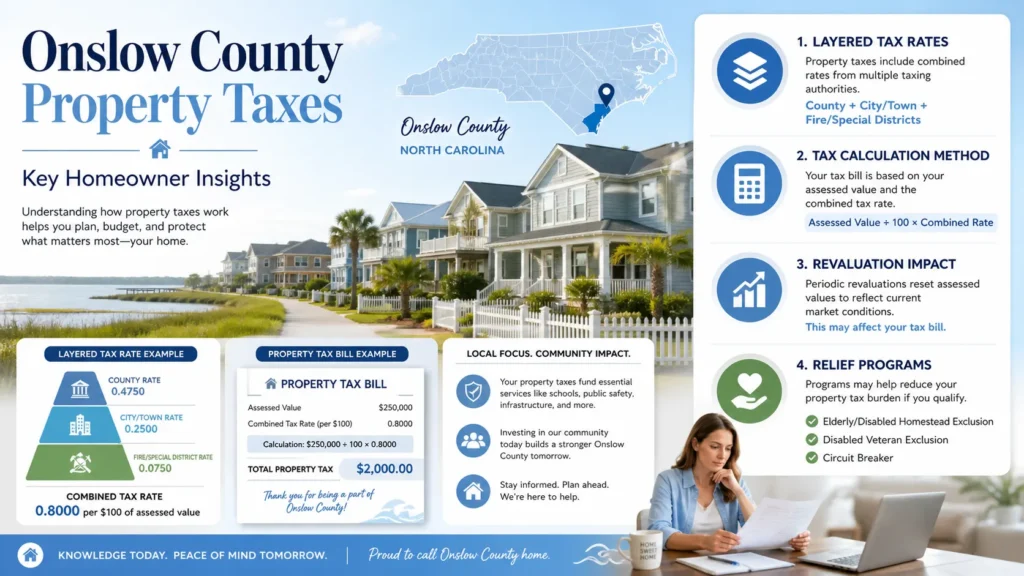
Onslow County property taxes start with a base county rate per $100 of assessed value. Your total bill adds any city, town, fire district, or special district rate that applies. The county adopts its rate yearly, posted on the official Onslow County tax rates page.
Homes in unincorporated areas pay at least the county rate. Homes inside a town or city have extra pieces stacked on top. That is why two similar homes rarely share the same bill.
Common add-ons include:
- Municipal taxes for Jacksonville, Swansboro, Richlands, Holly Ridge, and other towns
- Fire district taxes in some unincorporated areas
- Special district taxes tied to specific services
| Location | Rate layers that usually apply | Relative bill |
| Unincorporated county | County rate, possibly a fire district | Lower |
| Inside Jacksonville city limits | County rate plus city rate | Higher |
| Inside a smaller town | County rate plus town rate | Varies by town |
| Special service area | County rate plus district rate | Varies by district |
Imagine Home A inside Jacksonville and Home B just outside the city line. Both carry the same assessed value. Home A usually pays more because the city layer is added to the county layer.
Neighboring counties use the same layered approach. Our guides to Pender County property taxes and Brunswick County property taxes show how those systems compare.
How your Onslow County tax bill is actually calculated
Picture a call with your mortgage company after an escrow shortage notice arrives. Your monthly payment is jumping, and the tax math was never clear. The good news is that the formula itself is simple.
Onslow County divides your assessed value by 100, then multiplies by your total tax rate. The result is your annual property tax bill before relief programs or adjustments. You can find your assessed value through the county’s online tax bill search.
Here is the method in four steps:
- Find your assessed value on your bill or the county website
- Divide that value by 100 to get taxable units
- Add the county rate and any city or district rates
- Multiply your taxable units by the combined rate
For illustration only, a home assessed at $250,000 creates 2,500 taxable units. Multiply those units by the combined rate for that location. Always check current posted rates before trusting any figure.
| Value type | Who sets it | What it is used for |
| Assessed value | Onslow County | Calculating your property tax bill |
| Appraised value | A lender’s appraiser | Approving a mortgage loan |
| Market value | Today’s buyers | Setting a realistic sale price |
A home might sell for $300,000 today while its assessed value stays at $260,000. The assessed value, not the sale price, drives the tax bill. Between revaluations, assessments usually hold steady unless something physical changes.
Your assessment can change before the next revaluation if you:
- Build an addition or add a garage
- Finish usable space or substantially remodel
- Tear down a structure on the property
For rentals, the math is identical, but the impact feels different. Taxes come straight out of rent and can turn a thin-margin property into a break-even one. Escrow can also hide a rising tax burden until a shortage notice arrives.
When a home sells in North Carolina, buyer and seller split property taxes on the closing statement. Each side pays for the part of the year they owned the home. Lenders that escrow taxes collect monthly and pay the county when the bill comes due.
Revaluation and assessments in Onslow County: why your value can jump overnight
Picture a Sneads Ferry homeowner opening a revaluation notice and seeing a big jump. They added no rooms and changed nothing. Yet the county now says the home is worth much more.
A county-wide revaluation resets assessed values to better reflect current market conditions. It applies to every property, not just homes that sold or pulled permits. The statewide framework comes from Chapter 105 of the North Carolina General Statutes.
Revaluation changes your value, not your rate. Local boards may adjust rates afterward depending on budget needs. Owners still feel the increase when values rise faster than rates come down.
Why some areas jump more than others:
- Markets near Camp Lejeune, Swansboro, and Sneads Ferry move at different speeds
- Inherited homes that have not sold in years often see the biggest shocks
- Coastal demand can push values faster than inland neighborhoods
Local revaluation schedules can change, so check with the Onslow County Tax Office for current dates. Neighboring New Hanover went through a similar reset, covered in our New Hanover County property revaluation guide. The lessons there apply here too.
Before a revaluation hits, take these steps:
- Check your property record for wrong square footage or missing structures
- Review recent nearby sales for a practical sense of value
- Read every county notice carefully, because appeal windows are tied to timing
Onslow County property tax relief: exemptions and deferment programs
Picture an older Jacksonville homeowner on a fixed income, watching the tax bill creep up every year. They wonder whether any program could offer breathing room. For many owners, the answer is yes.
North Carolina has no across-the-board homestead cap for every owner. However, many Onslow County owner-occupants qualify for state relief based on age, disability, income, or veteran status. The NC Department of Revenue explains each of the state property tax relief programs.
| Program | Who it is for | How it helps |
| Elderly or Disabled Homestead Exclusion | Older or permanently disabled owners within income limits | Excludes part of the home’s value from taxation |
| Disabled Veteran Homestead Exclusion | Qualifying disabled veterans and certain surviving spouses | Excludes a set portion of the home’s value |
| Homestead Circuit Breaker | Eligible owners within income limits | Caps the bill as a share of income; the rest is deferred |
The Circuit Breaker works differently from the exclusions. The unpaid portion is deferred, not forgiven, and becomes a lien. It is usually repaid when the home sells or after the owner’s death.
Other exemptions apply in narrower cases, such as charitable properties or present-use value farmland. Income limits and exclusion amounts change, so always use current forms. Most stressed owner-occupants should start with the three homestead programs.
To apply, you will generally need to:
- Get current forms from the Onslow County Tax Office or NC Department of Revenue
- Document age, disability, income, veteran status, ownership, or residency
- File by the yearly deadline, or risk paying a higher bill that year
Approval is not always automatic in later years, so confirm whether reapplication is required. Keep copies of everything you submit to the county. If your income, health, or ownership changes, notify the Tax Office promptly to avoid surprise back taxes.
Appealing your Onslow County property tax assessment
Picture circling the new value on your notice, certain the county ignored your failing roof. Maybe the floors or foundation need serious work too. That is exactly when an appeal makes sense.
In North Carolina, you appeal the value placed on your home, not the tax rate. Rates come from local budget decisions. The NC Department of Revenue offers a helpful overview of property tax appeals in North Carolina.
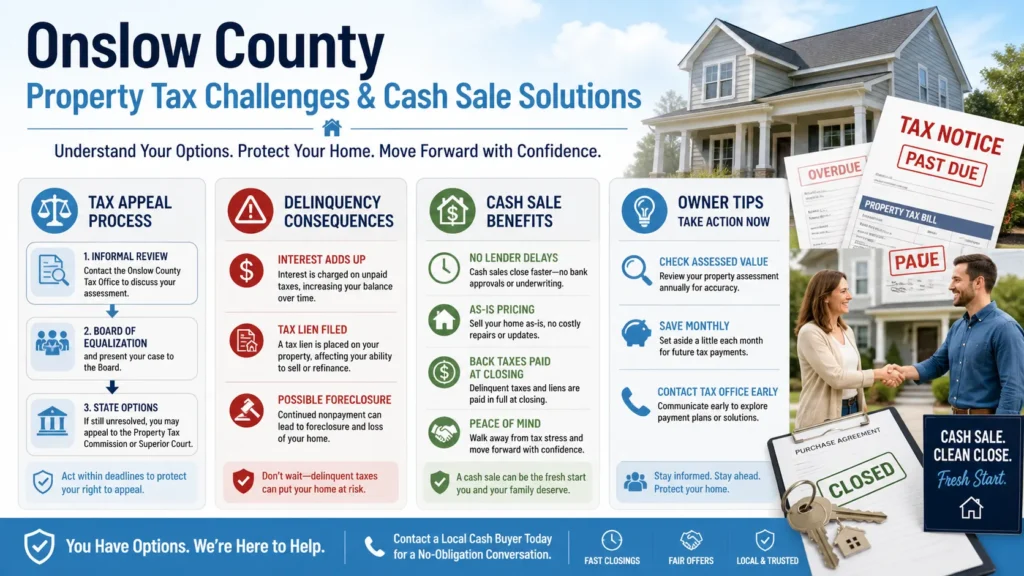
The appeal process typically follows three stages:
- Informal review. Ask the Onslow County Tax Office to review your value with supporting information.
- Board of Equalization and Review. File a formal appeal if the informal review does not resolve things.
- State-level options. Some cases move to the Property Tax Commission or courts, which takes more time.
Appeal windows are strict, especially around revaluation years. Confirm current dates with the county before assuming you still have time. Missing the window usually means waiting another year.
General frustration rarely moves the number. Strong evidence usually includes:
- Recent comparable sales from your neighborhood
- Contractor estimates for major repairs
- Photos showing damage or serious wear
- Correct measurements if the county record is wrong
A landlord with a rough rental in Hubert has a stronger case with repair bids and photos. Appeals can lower the value, leave it unchanged, or occasionally raise it. Increases happen when reviewers find features that were missing from the record.
Before filing, compare your property record line by line with the actual home. Simple errors in square footage or bathroom counts are the easiest wins. Fixing them sometimes resolves the issue without a formal hearing.
Key Onslow County tax deadlines and what happens if you fall behind
Picture opening a certified letter about delinquent taxes while older bills sit in a drawer. Your stomach drops, and you wonder how bad things could get. Understanding the timeline helps you act before choices narrow.
The general pattern is annual billing, an interest-free payment window, then delinquency after the deadline. Once delinquent, interest and other charges begin adding under state law. Confirm current dates directly with the Onslow County Tax Office rather than relying on memory.
A tax lien is the county’s legal claim against your property for unpaid taxes. It applies even when there is no mortgage. Left unpaid long enough, it can lead to collection or tax foreclosure.
| Stage | What typically happens |
| Original bill | County issues the annual tax bill |
| Past-due notices | Interest and charges begin after the deadline |
| Publication | Delinquent accounts may be published publicly |
| Tax foreclosure | The county may move to enforce the lien |
Common situations that lead to falling behind include:
- Out-of-state heirs assuming someone else is paying on an inherited house
- Landlords juggling vacancies and repairs who let bills slide
- Fixed-income owners hit by a revaluation jump
Shared family ownership often complicates who pays, as explained in our guide to heir property in North Carolina. Clear communication among heirs prevents many delinquencies. Acting early keeps more options on the table. A quick call to the Tax Office can clarify exactly what you owe.
Practical planning steps for every owner:
- Check your assessed value every few years for errors
- Divide last year’s bill by 12 and save that amount monthly
- Calendar relief-program deadlines each year
- Contact the tax office early if you already owe back taxes
- Run higher-tax scenarios before buying or holding rentals
Comparing Onslow with Wilmington-area properties? Both use layered county and city rates, so check exact layers before deciding. Insurance, flood risk, HOA dues, vacancy, and repairs matter just as much as taxes. Never assume one county is always cheaper without checking the actual property.
When a local cash sale can make Onslow County tax problems simpler
Picture finishing this guide and realizing that keeping the property still feels heavier than selling. You understand the math, relief programs, appeals, and delinquency risks. Yet the numbers simply no longer work for your family.
A cash sale cannot change tax laws or erase old bills by itself. It can, however, create a simpler path when a property becomes too costly to carry. Holding out for a higher price while paying years of taxes and repairs often leaves less money.
Here is how a local cash sale helps owners under tax pressure:
- No lender delays. The sale does not depend on buyer mortgage underwriting.
- As-is pricing. Older homes and repair needs are accounted for up front.
- Back taxes handled at closing. The closing attorney pays the county from proceeds.
- Full carrying costs considered. Taxes, insurance, repairs, and timing all shape the decision.
Landlords facing tenant problems alongside rising taxes may also find our NC eviction process for landlords guide useful. For some owners, a clean closing beats another year of chasing bills. That is especially true on fixed incomes or with rentals that stopped working.
ILM Home Offer is based in Wilmington and buys houses throughout Onslow County and coastal North Carolina. We review your property, tax situation, and timeline, then make a straightforward cash offer. There are no repairs, commissions, or lender delays, and often no out-of-pocket closing costs.
FAQs: Onslow County property taxes
What is the current Onslow County property tax rate?
The rate changes yearly. Your total equals the county rate per $100 of assessed value plus any city, town, or district rates. Check the county’s official tax rates page for current figures.
How do I appeal my Onslow County property tax assessment?
Start with an informal review at the Tax Office. If unresolved, file with the Board of Equalization and Review by the published deadline. Comparable sales, repair bids, and photos make the strongest evidence.
What exemptions might apply to Onslow County homeowners?
Owner-occupants may qualify for the Elderly or Disabled Homestead Exclusion, Disabled Veteran Homestead Exclusion, or Homestead Circuit Breaker. Each has age, disability, income, or veteran rules that can change yearly.
What happens if I pay Onslow County property taxes late?
After the payment window closes, bills become delinquent and interest begins. A tax lien secures the debt against your property. Left unpaid long enough, it can eventually lead to tax foreclosure.
Can I sell my Onslow County house if I am behind on taxes?
Usually, yes, if the home’s value covers what is owed. The closing attorney typically pays back taxes from sale proceeds. That clears the lien before ownership changes hands.
Do I need to make repairs before selling?
No, not with an as-is cash sale. Deferred maintenance, outdated finishes, and major repairs get factored into the offer. That matters when taxes, insurance, and penalties already stretch your budget thin.