


You’re staring at another text where the tenant promises to pay next week, and the mortgage is due with no rent in the account. It’s 11 p.m., and you’ve keyed in ‘NC eviction process for landlords’ into your phone. You’re torn between pushing through the legal steps or being done with tenants altogether.
In North Carolina, eviction is called summary ejectment, and it runs entirely through the court system. A landlord cannot legally regain possession through DIY lockouts, changed locks, or shut-off utilities. We’re not attorneys, and this isn’t legal advice, but here’s how the process, timelines, and tenant rights typically work for Wilmington-area landlords.
By the end of this guide, you’ll understand exactly when you can legally evict in North Carolina and what summary ejectment involves from start to finish.
Specifically, you’ll walk away knowing:
• When you can legally evict a tenant in NC, and what grounds qualify.
• Which notices and timelines apply to your specific lease type.
• The step-by-step court process, from filing to sheriff lockout.
• What rights tenants have, and how appeals can affect your timeline.
• What eviction really costs in time, money, and stress — and when selling as-is might be the smarter move.
NC Eviction Basics: What Is Summary Ejectment?
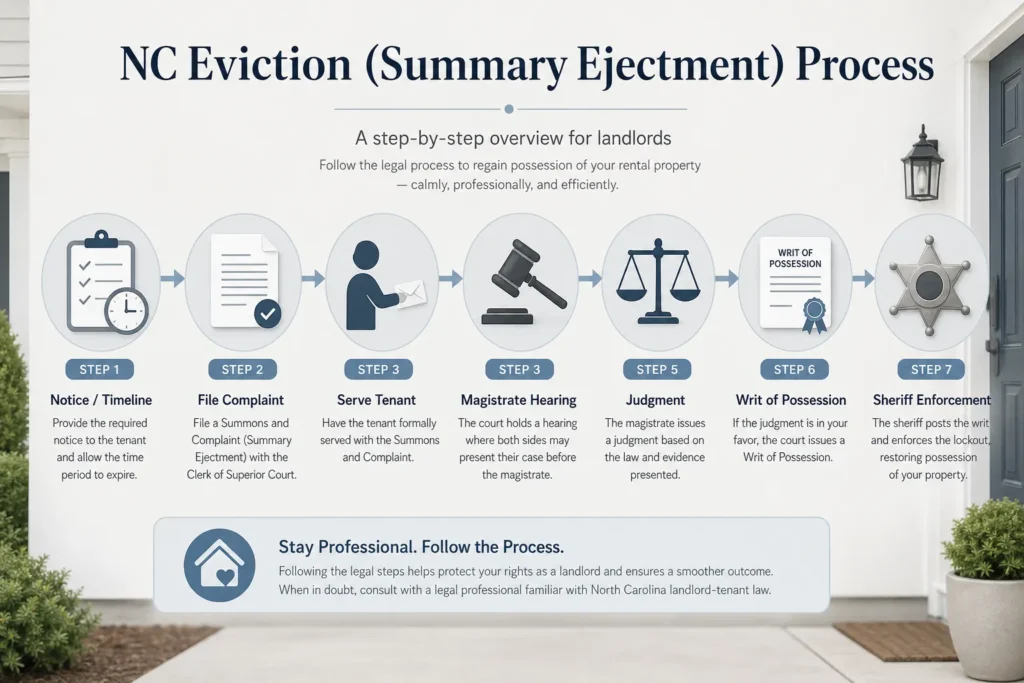
Summary ejectment is North Carolina’s court process for regaining possession when a tenant won’t leave voluntarily. It runs from filing a Complaint in Summary Ejectment, through service, a hearing, judgment, a writ of possession, and sheriff enforcement. As of August 2026, that’s the only lawful path — landlords cannot change locks, remove doors, or cut utilities to force a tenant out, regardless of how far behind on rent the tenant is.
Common lawful grounds for filing include:
• Non-payment of rent — the tenant has stopped paying with no resolution in sight.
• Serious lease violations — unauthorized occupants, banned pets, or damage beyond normal wear.
• Holdover after lease end — the tenant stays after proper notice to vacate.
• Illegal activity — conduct that breaches both the lease and the law.
Your written lease sets rent due dates and rules, but it can’t override NC tenant protections or authorize self-help eviction. Even if a lease claims the landlord can re-enter after non-payment, state law still requires the court process and sheriff enforcement. This guide covers typical residential rentals, not commercial leases, which can follow different rules.
Complex cases involving discrimination claims or counterclaims are strong signals to consult a North Carolina landlord-tenant attorney. If the process feels heavier than the rental is worth, selling as-is is one option worth comparing — see our About Us page for background on the local team behind that option.
If you’re tempted to speed things up on your own, resist it. Self-help moves can turn a straightforward case into a legal liability:
• Changing the locks while the tenant is away.
• Shutting off water, power, or gas to force a move-out.
• Removing doors, windows, or personal belongings from the unit.
• Threatening, harassing, or intimidating the tenant in any way.
Only a court order and the sheriff can lawfully remove someone from a rental in North Carolina.
Required NC Eviction Notices by Lease Type
Notice rules depend on your lease and tenancy type, and using the wrong one can get a case dismissed. Many non-payment cases start with a written 10-day demand, while month-to-month and year-to-year leases often use 7- or 30-day notices. These are common patterns, not guarantees, so confirm your specifics against official resources or an attorney before filing.
| Lease Type | Common Notice Type | Typical Minimum Notice |
| Week-to-week | Termination of tenancy | Often 2–7 days |
| Month-to-month | Termination or non-payment | Commonly 7 days |
| Year-to-year | Termination of tenancy | Commonly 30 days |
| Fixed-term lease | Notice only if ending early | Varies by lease |
| No written lease | Non-payment demand | 10-day demand is common |
A valid notice should include the date, tenant name, rental address, amount owed, deadline to pay or move, and a statement that filing may follow.
Avoid these common mistakes:
• Using a 30-day notice on a month-to-month tenancy.
• Relying on a text message instead of a written notice.
• Confusing a lease-termination notice with a pay-or-quit notice.
• Failing to document how and when notice was delivered.
These notice and eviction procedures trace back to North Carolina General Statutes Chapter 42, which governs landlord-tenant law statewide. Following the statute’s notice requirements precisely is what keeps your case moving instead of getting bounced back to square one.
Notices can be delivered by certified mail or sheriff service, but you must be able to prove delivery if challenged. Some landlords also hand-deliver a copy and photograph it posted on the door as extra proof. Repeated 10-day notices to the same tenant are often a sign of a bigger pattern worth reassessing.
Step-by-Step NC Eviction Process
North Carolina eviction typically runs 1 to 3 months from notice through sheriff lockout, though county backlogs and appeals can stretch that window. The process moves through a consistent sequence once notice has expired and the tenant hasn’t paid or left.
| Step | What Happens | Typical Timing |
| 1. Notice | Written demand or termination notice sent | 7–30 days, per lease |
| 2. File complaint | Complaint in Summary Ejectment filed in small-claims court | Same day as filing |
| 3. Service | Tenant served by sheriff or certified mail | Days after filing |
| 4. Hearing | Magistrate reviews lease, ledger, and notices | ~10–15 days after filing |
| 5. Appeal window | Tenant may appeal judgment | 10 days |
| 6. Writ & lockout | Sheriff enforces writ of possession | ~5 days after writ |
A magistrate typically reviews your documentation, hears both sides, and rules on possession and sometimes back rent within minutes of the case being called. Organizing your paperwork ahead of time makes that hearing far less stressful, whether it’s your first eviction or your fifth.
Bring these items to court:
• Lease agreement and any renewals or amendments.
• Payment ledger showing what was owed, paid, and outstanding.
• Copies of all notices, with delivery dates and methods.
• Photos, texts, or emails documenting the tenant’s conduct.
Throughout the process, avoid changing locks early, shutting off utilities, or intimidating the tenant. Self-help moves can expose you to liability even after you’ve won in court.
At the hearing itself, both sides get a chance to speak before the magistrate rules. Most hearings take only a few minutes once the case is called, but showing up organized makes a real difference in how smoothly it goes.
Picture a landlord who inherited a rental and hasn’t seen rent since spring. Frustrating as that is, following each step in order, without skipping ahead, is still the fastest and safest way to regain possession.
Wilmington and New Hanover County: Local Realities
Summary ejectment rules are statewide, but local practice shapes how the process feels. Most residential cases are heard in New Hanover County small-claims court, and your summons will list the exact courtroom, date, and time.
A few habits make court day smoother:
• Confirm your hearing details with the clerk or the small-claims court page.
• Plan for parking, security screening, and arrive early.
• Bring a simple folder with your lease, ledger, and notices.
• Budget the full morning off work in case the docket runs long.
Weather, holidays, or case-load surges can stretch or compress the usual 1-to-3-month timeline, so checking the court website the day before your hearing is worth the five minutes. Keeping a running log of tenant issues and payments also makes it much easier to walk a magistrate through what’s happened.
Some landlords decide another morning downtown is worth it to keep a property long term. Others, especially those on a second or third case with the same rental, start comparing that routine against selling as-is instead. Our where we buy houses page covers Wilmington and nearby NC markets if you’re weighing that option.
New Hanover County landlords often deal with seasonal rental turnover, coastal weather disruptions, and a courthouse that can get busy during peak filing periods. Building in extra buffer time around your hearing date, especially during hurricane season, can save you from an unnecessary reschedule.
Tenant Rights, Appeals, and Handling Belongings
North Carolina tenants have real rights during eviction: a court hearing before removal, freedom from self-help lockouts, and a 10-day window to appeal a judgment. An appeal can move the case to district court and stretch the timeline further, and a tenant may be able to stay if they post a bond or pay rent into court.
Even after winning, only the sheriff can physically remove a tenant, using the writ of possession as authority.
For belongings left behind:
• Follow NC law and local rules on storage and disposal.
• Document everything with photos or video before touching anything.
• Check official resources or an attorney before discarding items.
A few habits protect landlords through the whole process, whether the case is uncontested or the tenant pushes back:
• Keep a written timeline of payments, notices, and key events.
• Document property conditions and communications with photos or video.
• Communicate in writing whenever possible.
• Stay calm and factual, even if the tenant is upset.
Respecting tenant rights isn’t just about avoiding lawsuits — it’s what keeps the whole process fair and predictable for both sides.
The 10-day appeal window is also why patience matters even after a favorable judgment. Rushing to change locks before that window closes, or before the sheriff formally enforces the writ, can undo an otherwise solid case and expose you to a counterclaim.
For property-condition concerns tied to a tenant situation, see our guide on selling a house with water damage.
What NC Evictions Really Cost
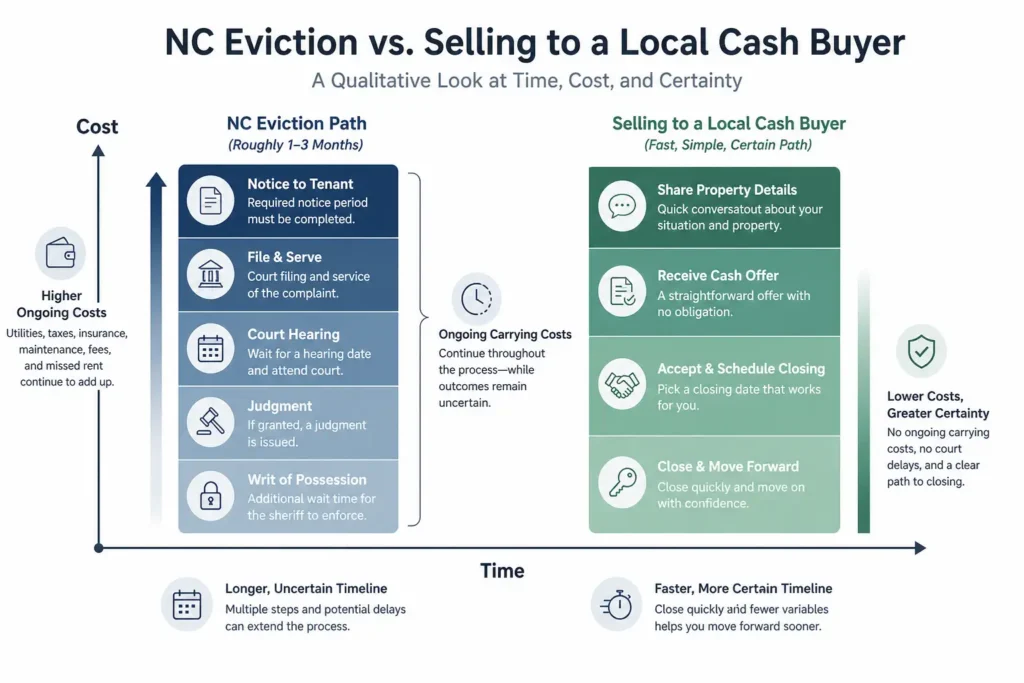
Beyond the 1-to-3-month timeline, evictions carry direct costs like filing fees, service fees, and possible attorney fees. Meanwhile, you’re still covering the mortgage, taxes, insurance, and utilities with no rent coming in.
Hidden costs add up fast too:
• Property damage risk while a checked-out tenant stays in place.
• Extra wear and tear on flooring, appliances, and systems.
• Time spent on notices, filings, and court appearances.
• The mental load of an unresolved situation dragging on for months.
| Cost Factor | Continuing Eviction | Selling As-Is |
| Timeline | 1–3+ months | Often a few weeks |
| Repairs | Landlord’s responsibility | Priced into offer |
| Commissions/closing costs | Typically landlord-paid | Often none |
| Certainty of outcome | Depends on court and appeals | Fixed offer and date |
A cash buyer can purchase as-is, price in tenant and repair risk, and close on your schedule. The key question isn’t gross rent recovered — it’s net proceeds after months of missed payments, court fees, repairs, and your own time are subtracted from either path.
Picture two landlords with identical rentals: one spends three more months on notices, court, and post-move-out repairs before listing; the other accepts a fair cash offer and closes in a few weeks. The first path might show a higher sale price on paper, but once missed rent and repair costs are subtracted, the numbers can end up surprisingly close.
If a non-paying tenant is pushing you toward default, our pages on selling a house in foreclosure and getting a cash offer today walk through both paths.
DIY, Attorney, or Sell: Choosing Your Path
There’s no single right answer for every NC landlord — the best path depends on complexity, time, and whether you want to keep being a landlord at all. DIY works well for straightforward non-payment cases where you can attend the hearing and follow official resources.
Hiring an attorney makes sense when tenants raise defenses, discrimination is alleged, or code violations complicate the case. A good landlord-tenant attorney can spot issues early and sometimes save money by avoiding delays caused by procedural mistakes. Landlords with limited budgets can also check free or low-cost legal help through organizations like Legal Aid of North Carolina.
Selling is worth a serious look if any of these sound familiar:
• You’ve filed against more than one tenant at this property.
• Repairs and deferred maintenance keep piling up.
• The rental is putting your own mortgage at risk.
• You’re simply done being a landlord.
Selling fits landlords facing repeat non-payment, major repairs, or mortgage strain who are simply done managing tenants. A local cash buyer can purchase as-is, work with tenants still in place, and skip commissions and closing costs. The right choice ultimately comes down to your stress level, available time, and whether being a landlord still fits your long-term goals.
None of these paths is inherently right or wrong — they simply serve different situations and different landlords. A first-time non-payment case with a cooperative tenant may call for the DIY route, while a property with years of turnover and repair headaches may point toward selling. Take an honest look at your specific situation before deciding.
Bottomline
North Carolina’s eviction process is a structured path of notices, filings, hearings, appeals, and sheriff enforcement — one you can follow yourself or with an attorney if keeping the rental fits your goals. Whichever route you choose, staying organized, documenting everything, and following the court process to the letter will serve you well.
If you’re more tired than motivated, selling as-is is a legitimate option worth comparing. Reach out for a transparent, no-obligation cash offer on your Wilmington-area rental and see which path leaves you with the clearest plan.
FAQ: NC Eviction and Selling a Tenant-Occupied Rental
What notices are required to start an eviction in North Carolina?
It depends on your lease, but many non-payment cases use a 10-day demand, while month-to-month and year-to-year leases often use 7- or 30-day notices. Always confirm with official resources.
What is summary ejectment?
It’s North Carolina’s court process for a landlord to legally regain possession when a tenant won’t leave, covering filing, service, hearing, judgment, and sheriff enforcement.
Can tenants appeal eviction judgments in NC?
Yes, tenants generally have 10 days to appeal, which can move the case to district court and extend the overall timeline beyond the typical 1-to-3-month range.
When should a landlord consider selling instead of evicting?
Selling fits repeat non-payment, major repairs, mortgage strain, or simple burnout. A cash buyer can purchase as-is on your schedule, with no commissions or closing costs.
Can I sell with a non-paying tenant still in place?
Often, yes. Local cash buyers are used to tenant issues and factor that risk into their offer, unlike traditional financed buyers who typically avoid occupied, non-performing rentals.
Do I need to repair anything before selling to a cash buyer?
Typically not. Cash buyers purchase as-is, including wear and tear or tenant-caused damage, and build those costs into the offer instead of requiring repairs first.