


If you are sitting at your kitchen table in Hampstead or Rocky Point with a higher Pender County value notice in your hand, the first worry is usually the same: what will this do to my tax bill and maybe my mortgage payment?
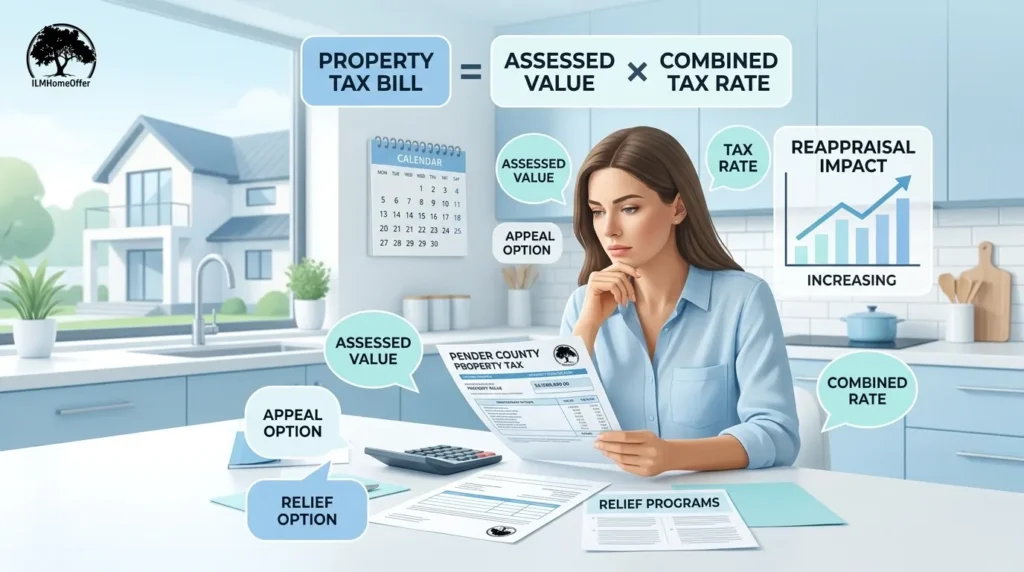
Here is the plain-English version of Pender County property taxes explained: your bill is based on your home’s assessed value from the county reappraisal multiplied by the combined local tax rate for the county, any town, and any special districts that apply to your property. A higher assessed value can push your bill up, but it does not always rise by the same percentage because the tax rate can change too.
If that still feels confusing, you are not alone. From what I have seen with Pender County owners, organized people can feel blindsided when a new value notice lands and they do not know how the county reached the number or what to do next.
In here, we will walk through how the property tax math works, what the reappraisal means for your bill, how to estimate the impact, when an appeal may make sense, what relief programs may be available, and when selling may be the more practical option if the house no longer fits your budget.
The goal is to talk through the numbers like a Wilmington-area neighbor, not a government brochure.
Pender County Property Taxes Explained in Plain English
Picture a homeowner in Burgaw who just pulled up a parcel record and cannot tell how the county turned that value into a bill. Your Pender County property tax bill is calculated by multiplying your assessed value by the combined tax rate for the county, any town, and any fire or special districts. Put simply, the county assigns a taxable value, then applies the local rate structure for your address.
Key terms to know:
| Term | What it means |
| Assessed value | The county’s taxable value for your property, set during reappraisal |
| Tax rate | The rate applied to assessed value to fund county, town, and district budgets |
| Combined rate | County rate plus any municipal or district rates for your address |
Those are two separate levers. If your assessed value rises and the rate falls, your bill may climb less than you fear. You can review the current rate structure directly through the NC Department of Revenue’s property tax division.
Pender County sets assessed values through its reappraisal process, and the value notice arrives first. The actual tax bill comes later, after rates and budgets are finalized. That gap can feel stressful because you see the new value before you know what it truly means for your wallet.
Once an owner understands that the bill depends on both value and rate, better questions follow. Is the value too high for the home’s condition? Are there exemptions worth checking? For broader regional context, ILM’s guide to property taxes in Wilmington, NC can help you compare nearby tax conversations.
Why the 2026 Pender County Reappraisal Made Values Jump
Picture someone in Hampstead holding a reappraisal notice, realizing the new value is far higher than the old one. The natural fear is that the tax bill will climb just as sharply. The 2026 Pender County reappraisal is a countywide reset of assessed values so records better reflect current market conditions. That can create sticker shock, especially where home prices moved quickly between cycles.
A reappraisal updates the county’s taxable value for properties across the county. It reviews property records, recent sales, and market patterns before assigning each parcel a new value. The reappraisal does not set your final bill by itself; local leaders still set tax rates through the budget process. You can review the county’s own explanation through the Pender County Tax Assessing office.
A big spike in assessed value does not automatically mean your bill rises by the same percentage. Two things happen at once:
- The assessed value changes with the reappraisal
- The tax rate is set through the local budget process
- Your final bill depends on how both pieces land together
A Rocky Point landlord may see the tax base on a rental rise while insurance and repairs already squeeze cash flow. A long-time Hampstead homeowner on a fixed income may feel the county’s number moved faster than their budget ever could. Higher assessments can also affect escrow, since a lender collecting too little may adjust your monthly payment. For household-budget context, see ILM’s guide to the cost of living in North Carolina.
Appraised Value vs. Tax Rate in Pender County
Imagine a retired couple in Burgaw trying to figure out whether their pain is coming from the new value, the rate, or both. The short answer: your appraised value and tax rate are separate pieces, and your bill comes from how they interact. Appraised value represents the county’s taxable value for the property, not a custom walk-through appraisal. The rate is not negotiated property by property.
A higher assessed value can still produce a smaller bill increase if the rate drops. A lower value can still produce a bigger bill if the rate rises instead. That is why you need to check both pieces before deciding what to do next.
| Can you fight it? | Assessed value | Tax rate |
| Appeal available | Yes | No |
| Set by | County reappraisal | Local budget process |
| Basis for change | Property-specific evidence | Countywide budget decisions |
What you can and cannot fight
This is where many Burgaw and Rocky Point owners get frustrated:
- You can appeal the assessed value if you believe the county overvalued your property.
- You cannot negotiate a personal tax rate for your individual home.
If you are thinking about an appeal, focus on evidence that the county’s value is wrong for your specific property. Condition problems, better comparable sales, or inaccurate property details are more useful than saying the bill feels unaffordable.
A denied appeal does not mean nothing can ever change. Values and rates can change in later cycles. But for the current bill, the appeal conversation is about accuracy, not budget strain.
For a regional comparison, ILM’s guide to property taxes in Wilmington, NC can help you see how county-level and city-level tax conversations differ.
Why these levers matter
A higher assessed value can still produce a less dramatic bill increase if the rate is adjusted downward. A lower assessed value can still produce a higher bill if the rate structure changes in the other direction.
That is why you need to look at both pieces before deciding what to do next.
Step-by-Step: Estimate Your Pender County Tax Bill
Picture a Hampstead homeowner on the couch late at night, trying to gauge what the new value could do to the budget. You can estimate your bill using your property record, applicable rates, and a simple calculation. Always confirm the final numbers through official county tools before relying on an estimate.
Follow these steps:
- Look up your assessed value through the county’s official property search tool
- Identify the rates that apply to your address, including county, town, and any fire district
- Add the applicable rates together into one combined rate
- Apply the formula: assessed value multiplied by the combined rate
- Compare your new estimate against last year’s bill
You can pay bills or check current balances anytime through the Pender County online tax payment portal. A Hampstead landlord may realize the higher tax burden eats into rental cash flow. A homeowner already facing a roof or HVAC repair may decide the property is becoming harder to justify.
If selling becomes part of the conversation after or instead of an appeal, ILM’s guide to closing costs for sellers in NC can help you compare the cost of holding on with the cost of exiting.
Appealing Your Pender County Property Value
Picture a Burgaw homeowner whose house needs major repairs, but the new county value looks like a renovated home. If you believe Pender County overvalued your property, you can appeal the assessed value through the county’s official process. Always confirm exact forms and deadlines directly with the county before filing.
Start by reading your notice carefully for the assessed value, appeal instructions, and filing window. Appeals are about accuracy, not affordability, so the county needs to see why its value may be wrong.
Useful evidence includes:
- Recent comparable sales
- Photos showing condition issues
- Contractor estimates for major repairs
- A recent independent appraisal
- Closing documents if you bought the home recently for less
Submit the official form and keep copies of everything, including confirmation of delivery. After filing, the county may review informally or schedule a formal hearing. Remember that an appeal can only adjust value, never the tax rate. If selling becomes part of the conversation, ILM’s guide to the cost of selling a house in NC can help you compare holding costs with exit costs.
Exemptions and Relief: Help for Pender County Homeowners
Picture a widowed homeowner in Hampstead living on a fixed check, wondering if any relief exists before considering a move. North Carolina and Pender County offer property tax relief programs for homeowners who meet specific criteria. Always confirm exact thresholds and deadlines with the Pender County Tax Administration office.
| Relief type | Who it’s generally for |
| Elderly or disabled homestead exclusion | Qualifying older or disabled homeowners meeting income limits |
| Disabled veteran exclusion | Qualifying disabled veterans or surviving spouses |
| Circuit breaker / deferral | Lower-income homeowners, with payback rules at sale |
To explore relief, homeowners typically need to:
- Get official application forms from the county or state
- Provide proof of age, income, disability, or veteran status
- Apply by the official deadline
- Keep copies of everything submitted
These programs are often underused because people simply do not know to ask. A disabled veteran in Rocky Point or a retiree in Hampstead may find relief helps enough to keep the house manageable. For a broader look at how property taxes fit into the household budget, you can read ILM’s guide on the cost of living in North Carolina.

When Rising Pender County Taxes Mean It Is Time to Sell
Picture a Rocky Point landlord opening an escrow shortage notice, realizing the rental now feels more like a yearly bill than an asset. Rising Pender County property taxes can be the nudge to seriously consider selling, especially stacked on insurance, HOA dues, and repairs.
Common red-flag situations include:
- A retiree in Burgaw on a fixed income with little budget room left
- A tired landlord in Rocky Point where taxes climb faster than rent
- An heir with a Hampstead-area property rarely used but still taxed
In each case, the tax bill is only one piece of the carrying-cost picture. Add a roof, HVAC system, or storm wear, and the cost of standing still gets heavy. Selling is not right for every owner, but it is worth comparing ongoing carrying costs against net sale proceeds. For a closer look at what sellers actually keep, see ILM’s guide to closing costs for sellers in NC.
If a Cash Sale Becomes the Practical Next Step
Picture a Pender County homeowner who has checked the county portal, looked at relief options, considered an appeal, and still feels the property is too expensive to carry.
A cash-buyer path is not right for everyone, but it can reduce some of the friction that makes a traditional sale difficult when taxes, repairs, and timelines are already stressful.
Here is what that path can change:
- No lender approval tied to a buyer’s financing — A cash sale does not depend on a buyer’s mortgage approval.
- As-is sale structure — An as-is buyer can factor repairs into the offer instead of requiring the seller to take on major projects before closing.
- Carrying costs considered upfront — Taxes, insurance, repairs, and timing all affect what a seller actually nets. A clear offer should account for those costs rather than leaving them as surprises later.
- A cleaner break from future bills — After closing, the seller is no longer carrying that property’s future Pender County tax bills.
The point is not that every owner should sell. The point is that if the tax math no longer works after you have checked appeals and relief, selling as-is may be worth comparing with another year of bills, repairs, and escrow adjustments.
ILM Home Offer is based at 321 N Front St., Wilmington, NC 28401 and serves nearby coastal communities, including Pender County areas such as Hampstead, Rocky Point, and Burgaw.
Will high property taxes or a big 2026 value jump scare off a cash buyer like ILM Home Offer?
A higher tax bill is not automatically a deal-breaker for a cash buyer. It becomes part of the overall picture along with property condition, timing, liens, and what the seller needs from the sale.
If you are in Hampstead, Rocky Point, Burgaw, Surf City, or another Pender County community staring at a higher value notice, the next step is to slow the problem down and work through the pieces.
You have seen how assessed value and tax rates interact, why a reappraisal can feel so jarring, how to estimate the bill, where appeals and relief programs may fit, and when selling may deserve a serious look.
For some people, an appeal or relief program will be enough. For others, the honest answer is that keeping the house means more years of tight budgets, repairs, insurance pressure, and anxiety every time a new bill arrives.
Bottomline: Pender County Property Taxes
If you have run the numbers and want a simpler path, ILM Home Offer is a Wilmington-based cash buyer that works with homeowners in Pender County and surrounding coastal communities. We buy houses as-is, with no repair or rewire project, no waiting on lender approval, no repair negotiations, no commissions, and often no closing costs out of your pocket.
You can call (910) 742-0414 or use ILM’s cash-offer form for a straightforward conversation about your specific situation. You do not have to decide today. You just deserve clear options before the tax bill controls the decision for you.
FAQs: Pender County Property Taxes
What are Pender County property taxes in Wilmington, NC?
Pender County property taxes are annual charges on property located in Pender County. They are based on the county’s assessed value for the property and the local rates that apply to its location, including any town or district rates.
How does the 2026 Pender County reappraisal affect my tax bill?
The reappraisal updates the county’s assessed value for your property. A higher value can increase your bill, but the final amount still depends on the rates set for the county, towns, and districts that apply to your address.
What steps should I take to estimate my Pender County property tax bill?
Start by looking up your assessed value on the official county property tool, then find the tax rates that apply to your address. Add the applicable rates, apply them to the assessed value using the county’s rate format, and compare the estimate with your prior bill.
What exemptions or relief options could reduce my Pender County tax bill?
Relief may be available for qualifying homeowners, including older homeowners, disabled homeowners, disabled veterans, or certain lower-income owners. Eligibility rules, deadlines, and application forms must be checked through official NC Department of Revenue and Pender County sources before relying on them.
Do I have to fix up my Pender County house before selling if I cannot afford the new taxes?
Not necessarily. A traditional sale may involve repair requests, but an as-is cash buyer can price needed repairs into the offer so you do not have to complete major projects before selling.
Can I sell my Pender County home as-is to a cash buyer even if I am behind on taxes?
In many cases, yes. Back taxes are commonly handled through closing from the sale proceeds, depending on the amount owed and any other liens tied to the property.
Will high property taxes or a big 2026 value jump scare off a cash buyer like ILM Home Offer?
A higher tax bill is not automatically a deal-breaker for a cash buyer. It becomes part of the overall picture along with property condition, timing, liens, and what the seller needs from the sale.