
Picture a letter from your lender saying your Wilmington home sits in a high-risk Cape Fear flood zone. It is late, you are scrolling flood maps, and one worry keeps returning. Maybe this house is now impossible to sell.
Here is the good news. Cape Fear flood zones are labels on a map, not a verdict on your future. Plenty of local homes sit in a mapped zone and still sell every year.
This guide explains what Wilmington flood zones mean in plain English. It covers how to check a property, how flood risk shapes price and insurance, and what options you have. It is not legal, engineering, or insurance advice, so confirm details with qualified professionals.
What Cape Fear Flood Zones Mean for Wilmington Homes
Your agent mentions the home is in Zone AE near the Cape Fear River. All you hear is “flood,” and your stomach drops. Let’s slow down and decode what that label actually says.
A flood zone describes the relative chance an area may flood over time. It is about probability, not a promise that water will reach your door. Around Wilmington, these maps reflect the river, coastal waters, creeks, drainage, and low ground.
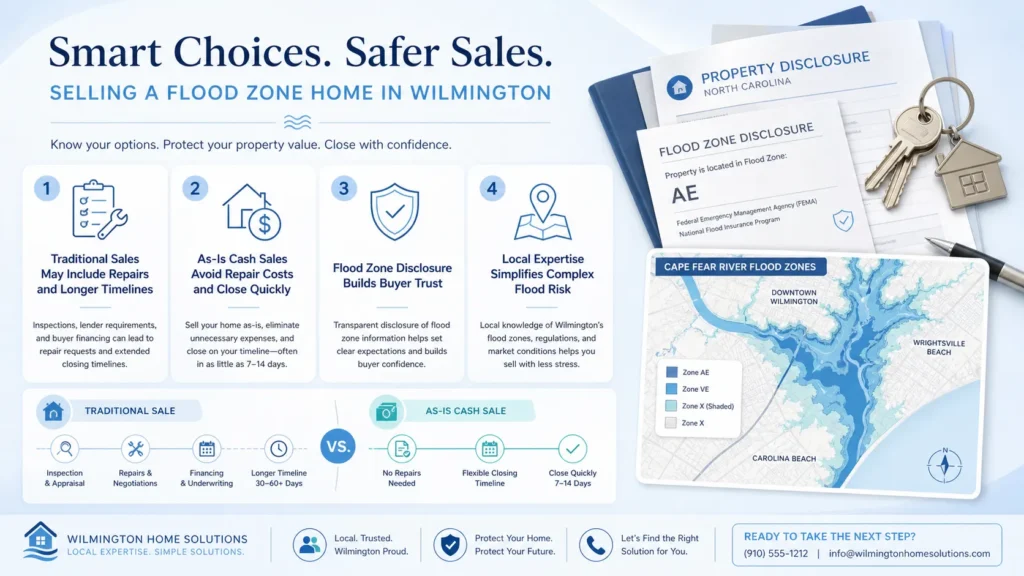
FEMA defines its flood zone designations on official Flood Insurance Rate Maps. Higher-risk zones fall inside the Special Flood Hazard Area, meaning a 1% or greater annual flood chance. Here is how the codes you will see most often compare:
| Zone code | General risk level | What it usually signals |
| AE | Higher risk (SFHA) | Riverine or coastal flooding with defined base flood elevations |
| VE | Higher risk (SFHA) | Coastal areas exposed to wave action and storm surge |
| AO / AH | Higher risk (SFHA) | Shallow flooding or ponding in low-lying areas |
| Shaded X | Moderate risk | Areas between the 1% and 0.2% annual chance floodplains |
| Unshaded X | Lower risk | Outside mapped higher-risk areas, but not risk-free |
Two homes in the same ZIP code can carry different labels. One may sit slightly higher, drain better, or lie farther from the water. That is why experienced buyers treat the code as one part of the picture.
• Condition: Is there past water damage or moisture?
• Elevation: How high does the house sit relative to nearby flood levels?
• Access: Do nearby roads hold water during storms?
• Insurance: What will coverage realistically cost each year?
This plain-English overview cannot replace official map documentation. Use it to ask sharper questions of your agent, lender, and insurance contact.
How to Look Up a Wilmington Property’s Flood Zone
You type your address into three websites and get three different answers. One looks high-risk, another moderate, another a patchwork of colors. Which map actually matters for your sale?
Start with official sources, then use other tools as a cross-check. The North Carolina Flood Risk Information System and the FEMA Flood Map Service Center are the best starting points. Lenders, insurers, and local officials rely on these official maps.
Follow these steps to check any Wilmington property:
1. Open an official map. Use the NC or FEMA tool rather than a listing screenshot.
2. Enter the full address. Include street, city, and ZIP so the map centers on the parcel.
3. Turn on the flood-zone layer. Make sure shading and zone codes are visible.
4. Click the parcel. Note the zone code and any base flood elevation shown.
5. Save a copy. Export or screenshot the view with the address clearly visible.
Local county GIS viewers may add drainage, stormwater, or parcel layers. Private risk-score sites can show broader patterns and long-term outlooks. Neither replaces the official map used in lender and insurance decisions.
Keep these limits in mind before relying on any single result:
- Maps are models, and boundaries can shift after new flood studies.
- Different tools use different assumptions and update schedules.
- A map cannot replace an elevation certificate or a real insurance quote.
- Ask your insurance agent to quote the same address and zone you found.
If you sell to a buyer who regularly purchases Wilmington homes, they usually handle this map work. That does not mean you should ignore it. You simply do not need to become a flood-map expert.
Why Wilmington Floods and How Often It Matters
You remember rerouting around a flooded intersection after a big storm. A quiet thought stuck with you afterward. If the street looks like this, what happens to the house long term?
Flooding here comes from several directions, and it varies across town. Some events leave nuisance water in low spots. Others push water into yards, crawlspaces, or homes.
The main drivers of flooding in the Cape Fear basin include:
• Heavy rainfall: Intense storms can overwhelm drains, ditches, and retention ponds.
• Rising river levels: Upstream rain can raise the Cape Fear and affect low areas downstream.
• Storm surge: Hurricanes and tropical storms can push water inland through rivers and waterways.
• High tides: Seasonal and king tides raise water levels, especially when wind and rain add pressure.
Two houses on the same road can have very different flood experiences. One may sit higher, while another has a low yard or shallow crawlspace. Risk often shifts with river distance, drainage, and elevation more than ZIP code.
For owners and investors, real-world flood risk shows up in three practical ways:
• Access: Roads may close temporarily during larger events.
• Building systems: HVAC units, ductwork, and water heaters in low spots are vulnerable.
• Downtime: Drying out and repairing after a serious flood takes time and money.
Repeated water exposure often leads to crawl space moisture problems common across coastal NC homes. Experienced buyers separate nuisance water from serious damage, then price accordingly.
How Flood Zones Affect Wilmington Home Prices and Financing
You are comparing two offers at the kitchen table. One is higher, from a financed buyer nervous about the flood map. The other is a lower cash offer that closes faster with no repair list.
A flood zone does not make a home worthless, but it reshapes the buyer pool. Some owner-occupants and out-of-town buyers walk away from flood insurance and storm risk. Local buyers may stay interested but expect the risk reflected in price.
Here is how different buyers typically react to a higher-risk label:
• Out-of-town buyers: Often skip flood-zone listings entirely.
• Financed buyers: Worry about insurance raising monthly payments.
• Local investors: Stay interested but price in risk and repairs.
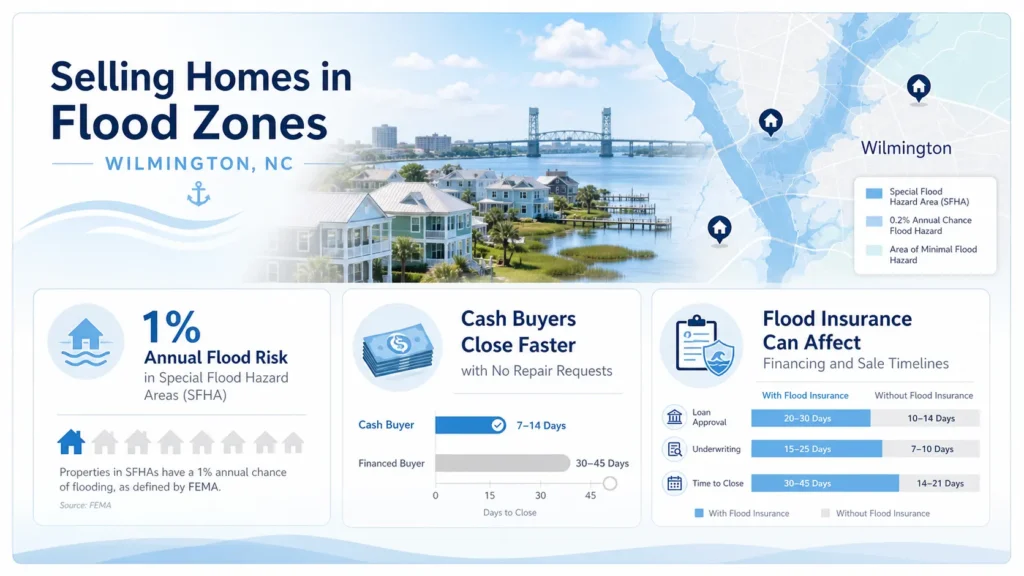
Lenders and appraisers add another layer of friction. A lender may require flood insurance, elevation data, or property history before approving a loan. Higher perceived risk can slow or complicate financed deals.
Investors use risk-adjusted pricing, working backward from expected insurance, repairs, vacancy, and access problems. For sellers, the number that matters is net proceeds, not the headline price. Here is how two common paths compare:
| Factor | Traditional financed sale | As-is cash sale |
| Contract price | Often higher on paper | Usually lower, reflects risk |
| Repairs | Buyer may request after inspection | Typically none required |
| Lender flood requirements | Can delay or derail closing | Not a closing hurdle |
| Timeline | Longer, with more holding costs | Often faster |
| Commissions and fees | Usually apply | Often reduced or none |
| Certainty | Depends on financing and appraisal | Generally higher |
Before comparing offers, list every cost a traditional sale may add:
- Repairs requested after inspection or required before closing.
- Insurance, utilities, taxes, and loan payments while the home sits on the market.
- Agent commissions and seller-paid closing costs.
- Price reductions if financed buyers back out over flood concerns.
Once repairs, holding costs, and commissions are included, the gap often narrows. Sometimes the cleaner cash offer leaves more in your pocket. Our guide to selling a house in a flood zone in North Carolina walks through this math in more detail.
Flood Insurance Basics for Wilmington and Cape Fear Zones
You add a new flood-insurance estimate to your budget and watch the monthly cost jump. Suddenly that zone letter feels much heavier. Insurance is one of the biggest reasons flood zones matter in real estate.
Federally backed mortgages on homes inside a Special Flood Hazard Area generally require flood insurance. FloodSmart, the official National Flood Insurance Program site, explains coverage options and requirements. Owners outside high-risk zones can still buy coverage voluntarily.
Keep these basics in mind as a Wilmington owner:
• Premiums depend on more than the zone. Elevation, foundation type, building age, and prior claims all matter.
• Rating methods and maps change. New flood studies or rating updates can shift what you pay over time.
• Wind is separate. Standard flood policies do not cover wind damage, so coastal owners often carry both.
• Assistance programs vary. Confirm any grant or elevation-assistance program on official government sites before counting on it.
Flood premiums are highly property-specific, so no single number applies to every home. Get quotes early and ask a licensed agent to explain what drives your premium. You can also review hurricane insurance costs in coastal North Carolina to see the full coverage picture.
Some owners eventually tire of premiums, elevation paperwork, and lender requirements every year. For them, selling becomes a practical way to hand off the long-term insurance puzzle.
Due-Diligence Checklist and Micro-Location Patterns
You have a home under contract near the river, and the inspection clock is ticking. You need to decide whether the flood risk is manageable or a reason to walk. A structured checklist keeps emotions out of the decision.
Use this checklist when buying or evaluating a Wilmington flood-zone property:
| Checklist item | What to look for |
| Verify the flood zone | Confirm the parcel code on official NC and FEMA maps |
| Gather records | Elevation certificate, prior insurance declarations, claim history |
| Ask about past water | Written answers backed by invoices, photos, or contractor notes |
| Get insurance quotes | Real premiums from a licensed agent during due diligence |
| Walk it after rain | Standing water, soft ground, overwhelmed drains, runoff patterns |
| Check access | Which nearby roads tend to flood during storms |
| Price repairs | Contractor estimates for grading, drainage, sump pumps, or vents |
Sellers should also understand disclosure duties. The North Carolina Real Estate Commission publishes the residential disclosure statement, which includes flood-related questions. Our breakdown of the North Carolina seller disclosure form explains what sellers typically need to share.
Flood risk around Wilmington changes block by block, not neighborhood by neighborhood. Homes near the river, Intracoastal Waterway, creeks, and marshes often show higher-risk labels. Inland homes on higher ground may still face drainage problems during heavy rain.
When you walk a property, watch for these on-the-ground clues:
• Storm drains, ditches, swales, and retention ponds nearby.
• Grading that directs water away from the foundation.
• Staining or tide lines on pilings, fences, or foundation blocks.
• What long-time neighbors say about past storms.
A neighborhood’s reputation says little about how one parcel handles water. Official maps and on-site observations are better guides than hearsay. Experienced local buyers learn these micro-patterns by watching properties through many storms.
Your Options If Your Wilmington Home Is in a High-Risk Flood Zone
You are holding a contractor’s drainage estimate and a higher insurance renewal notice. Neither number feels realistic. Should you keep pouring money into the house or move on?
You still have choices, and laying them out side by side helps. None is perfect, but each fits a different budget and stress level. Here is how they compare:
| Option | Best for | Main tradeoff |
| Stay and improve | Owners with savings and long-term plans | Upfront costs for drainage, vents, or elevation |
| Manage insurance and reserves | Owners comfortable with ongoing risk | Higher premiums and larger emergency savings |
| Change how it’s used | Landlords or families reconsidering fit | Must follow local zoning, HOA, and rental rules |
| Sell with transparency | Owners ready to move on | Price reflects flood risk and condition |
Staying often means targeted upgrades like better grading, sump pumps, flood vents, or elevated mechanical systems. These projects need real contractor bids and sometimes engineering or code review. Insurance-focused owners should compare deductibles and build reserves for temporary housing after storms.
Landlords sometimes reconsider whether a flood-prone rental still makes financial sense. Any change in use should be checked against current city, county, HOA, and rental rules first.
If you decide to sell, transparency builds trust with serious buyers. Share these documents to support a smoother sale:
- Flood-zone maps you have reviewed.
- Elevation certificates, if available.
- Prior insurance information, where appropriate.
- Records of drainage or moisture work already completed.
High-risk homes by the river, inherited houses, and storm-worn rentals still change hands. Local cash buyers who understand Wilmington flood zones often buy as-is and take on future repairs. If repairs feel out of reach, you can sell your Wilmington house as-is without funding a major project first.
A flood-zone label is only one piece of your property’s story. You can improve, insure, or sell to someone comfortable with the long-term risk. You do not have to fix everything before you move on.
FAQs: Cape Fear Flood Zones
What map shows flood zones in Wilmington, NC?
Start with the North Carolina Flood Risk Information System and the FEMA Flood Map Service Center. Search by address, review the parcel’s zone code, and confirm details with your lender, insurance agent, or surveyor.
How do Cape Fear flood zones affect property values?
Higher-risk zones can narrow the buyer pool and add lender friction. Buyers often price in insurance, repairs, and access concerns. Sellers should compare net proceeds after costs, not just the highest contract price.
Is flood insurance required in high-risk Wilmington flood zones?
Federally backed mortgages on homes inside a Special Flood Hazard Area generally require flood insurance. Owners in lower-risk zones can still buy coverage. Premiums vary widely, so get quotes from a licensed agent early.
Can I sell my Wilmington house as-is in a flood zone?
Yes. Many local cash buyers purchase flood-zone homes as-is. Success depends on realistic pricing, honest disclosure of known water issues, and documentation that helps buyers understand the property’s history.
Do I need flood-related repairs before selling to a cash buyer?
Usually not. Cash buyers who specialize in local properties often accept moisture problems, dated drainage, or past flooding. Major safety or structural issues may affect the offer amount, but not the ability to sell.
Can a cash buyer close if my lender or insurer has flood concerns?
Yes. A cash buyer is not relying on a new mortgage, so lender flood-insurance requirements do not block closing. The buyer still evaluates risk, but it shows up in the offer, not a loan denial.