


A practical guide to July 2026 ZIP Code 28443 metrics, underwriting checks, flood diligence, forecast scenarios, and data verification for real estate investors.
An investor comparing two Hampstead market pages can see a London featured snippet beside ZIP Code 28443 figures, then carry the wrong geography into a real acquisition model. That is not a minor research error. A mislabeled market, stale portal number, or listing metric treated as an after-repair value can change an offer price and exit assumption.
The Hampstead NC housing market is not a buy-or-pass label. It is a set of dated ZIP-level metrics and property-level assumptions that must survive the acquisition and exit model. For investors evaluating Hampstead, North Carolina, the useful question is not whether a portal calls the market hot. It is whether the exact property can support its purchase price, repairs, insurance, financing, holding period, rent or resale assumptions, and exit liquidity.
Consumer portals can provide a starting point, but active investors need the decision layer that separates a July 2026 ZIP Code 28443 listing snapshot from a completed sale, a rent comparable, or an ARV. We use that separation throughout this guide so operators can keep their attention on acquisitions instead of chasing a number that merely makes the deal look workable.
Hampstead NC Housing Market Snapshot: The Numbers That Matter Now
A seller can cite a high asking price, while the investor’s exit model depends on what the ZIP Code 28443 data actually measures. The direct answer is that the July 2026 snapshot shows a substantial asking-price baseline and active inventory, but it does not establish an appraisal value, ARV, or universal Hampstead value.
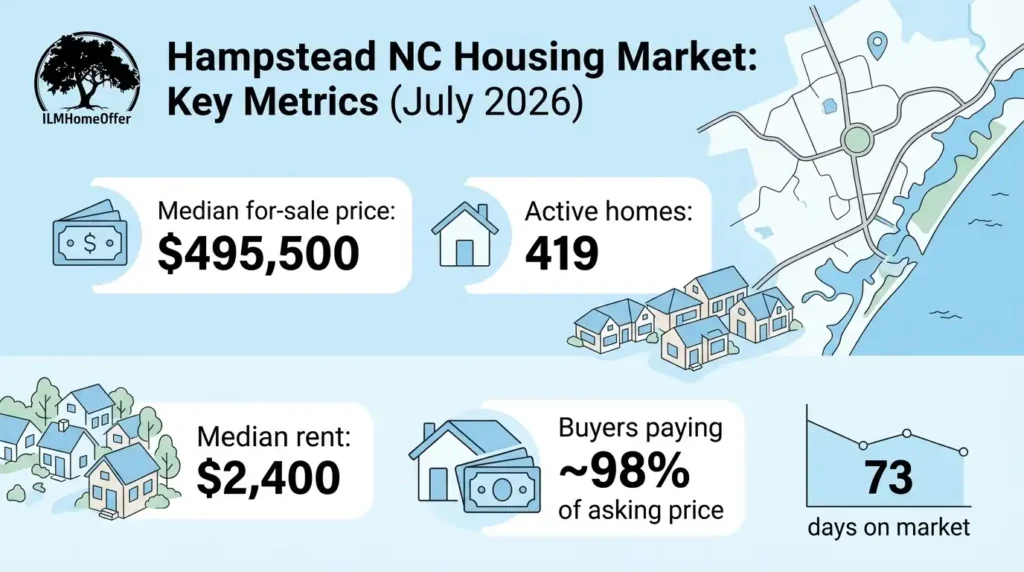
Realtor.com’s July 2026 ZIP Code 28443 market page reported a median for-sale price of $495,500, 419 active homes, 73 days on market, $222 per square foot, median rent of $2,400, and buyers paying about 98% of asking price. Every figure below is a portal metric for ZIP Code 28443 in July 2026.
| Metric | ZIP Code 28443, July 2026 | What it does and does not tell an investor |
| Median for-sale price | $495,500 | A listing-side midpoint, not a sold-price comp or ARV. |
| Active homes | 419 | A dated inventory snapshot, not a measure of every competing property. |
| Days on market | 73 | A listing-time measure that needs property-level context. |
| Price per square foot | $222 | A broad portal measure, not a substitute for condition-adjusted comps. |
| Median rent | $2,400 | A portal benchmark, not a property-specific rent comp. |
| Buyers paying about | 98% of asking price | A list-to-sale relationship, not proof that a specific seller will negotiate by 2%. |
Definition: Median listing price is the median asking price within a specified geography and month, while median days on market is the median time listings spend on market in that geography and month. Sold prices reflect completed transactions, and neither measure is automatically ARV.
The number that matters is the one tied to the property, the condition, and the exit.
What this means by strategy:
- Wholesaler: 73 days on market may point to a listing worth qualifying further, not a blanket discount assumption.
- Flipper: $222 per square foot is only a starting screen until closed-sale comps establish the likely resale range.
- Buy-and-hold operator: The median rent figure cannot replace current comparable rentals, operating costs, insurance, or vacancy assumptions.
Use this snapshot to frame questions. Do not blend it with a city page, county data, a different portal update, or an older market view. The same table can look more certain than it is when the labels disappear.
Quick Reference: Portal Metric vs. Investor-Grade Metric
| Portal metric (what you see) | Investor-grade equivalent (what you need) | Where to get it |
| Median listing price | Closed-sale comps adjusted for condition/size/location | MLS, title/escrow data, agent pull |
| Days on market | Property-specific reason for time on market (condition, price, defect) | Listing history, agent notes |
| Price per square foot | Comparable-adjusted ARV | Recent closed sales within the submarket |
| Median rent | Current comparable lease rates for the specific property type/condition | Rental comps, property managers |
| List-to-sale ratio (98%) | Actual negotiated discount for this seller/property | Direct negotiation, seller disclosure |
What the Current Market Means for Buy-and-Hold, Flips, and Wholesale Deals
A wholesaler can see 73 days on market and ask whether it means more negotiation room or simply a property with an exit problem. There is no defensible universal yes or no for Hampstead. The July 2026 ZIP Code 28443 snapshot provides context, but each strategy needs its own deal test.
The ZIP Code 28443 snapshot reported 73 days on market and buyers paying about 98% of asking price in July 2026. Those listing-side measures can help frame a negotiation, but they cannot prove a discount, resale timeline, or buyer demand for one house.
Definition: Listing-side measures describe asking prices and market time, while completed-sale measures describe transactions that have already closed. Neither is automatically an ARV.
By strategy, test these before you commit:
- Buy-and-hold:
- Current rental comparables (not the portal median)
- Property-specific operating costs
- Insurance quotes
- Financing terms
- Vacancy assumptions
- Condition required to attract the intended tenant
- Flip:
- Closed-sale comps and a realistic repair scope
- Holding period tested against financing, insurance, utilities, and selling costs
- Resale liquidity — a property that sits longer than expected can consume projected margin even if the final sale price stays close to plan
- Wholesale:
- Seller’s willingness to discuss price vs. an end buyer’s willingness to take the assignment
- Whether the contract leaves room for repair risk, holding risk, financing constraints, and the local buyer pool
- Whether a stale listing signals opportunity or a title, condition, insurance, financing, or exit issue
A market label does not replace a deal model.
Hampstead Housing Market Forecast: Use Scenarios, Not a Price Promise
A flipper can project resale from a rising-market assumption, then find that the hold period or offer price needs revision before closing. A responsible Hampstead forecast is conditional, not a precise future-price prediction. We would model upside, base-case, and downside conditions before relying on any one market narrative.
Forecasts are useful only when they change an assumption you can test.
| Scenario | What has to be true | What it means for underwriting |
| Upside | Inventory stays manageable for the intended buyer segment; days on market stays within the underwriting window; rent/resale demand supports the exit; insurance and financing costs stay within model | Some flexibility exists, but confirm each driver before adjusting the offer |
| Base case | Inventory, market time, price reductions, rent comps, and financing move without a clear directional signal | Underwrite with conservative repairs, holding costs, and exit assumptions — not appreciation |
| Downside | Inventory rises, price reductions increase, days on market lengthens, insurance exceeds model, financing worsens, or buyer/tenant demand weakens | Offer price and planned hold period must absorb this risk before contract |
Definition: A scenario is a set of explicit assumptions used to test whether a deal still works under different market conditions. It is not a prediction that one outcome will occur.
Review a consistent monthly series using the same geography and metric definitions. Monitor inventory, listing and sold-price measures separately, days on market, price reductions, current rent comparables, insurance quotes, and financing terms. Before treating new supply as a market fact, use Pender County’s official inspections and permitting resources to locate dated planning, permitting, and site-development information.
Where Investor Opportunities May Exist in Hampstead
An investor can find a listing that has sat long enough to justify a lower offer, yet still needs to determine whether the delay reflects seller flexibility or an unfinanceable property problem. Opportunities in Hampstead are property and seller situations to screen, not universal neighborhood rankings or price-band shortcuts.
Start with observable evidence:
- Compare listing age and price-change history with the current property condition.
- Separate deferred maintenance that can be scoped from defects that may change financing, insurance, or resale eligibility — a property with storm-related damage, for example, carries different underwriting math than one with cosmetic wear, as this breakdown of what to know before repairing or selling a hurricane-damaged house in Wilmington lays out.
- Qualify the seller’s stated timeline and constraints without assuming that a price reduction proves motivation.
- Test resale liquidity against closed-sale comparables, buyer expectations, and the likely repair scope.
- Validate rental demand with current comparable rentals, not a portal median.
- Confirm property-use constraints, title items, HOA requirements, zoning, and insurance considerations at the property level before presenting an offer.
Definition: Motivated-seller signals are observable circumstances, such as deferred maintenance, stale marketing, or price reductions, that may justify further qualification but do not prove seller motivation.
A lead becomes an opportunity only after the property, seller context, and exit all survive the same review.
How to Underwrite a Hampstead Deal in This Market
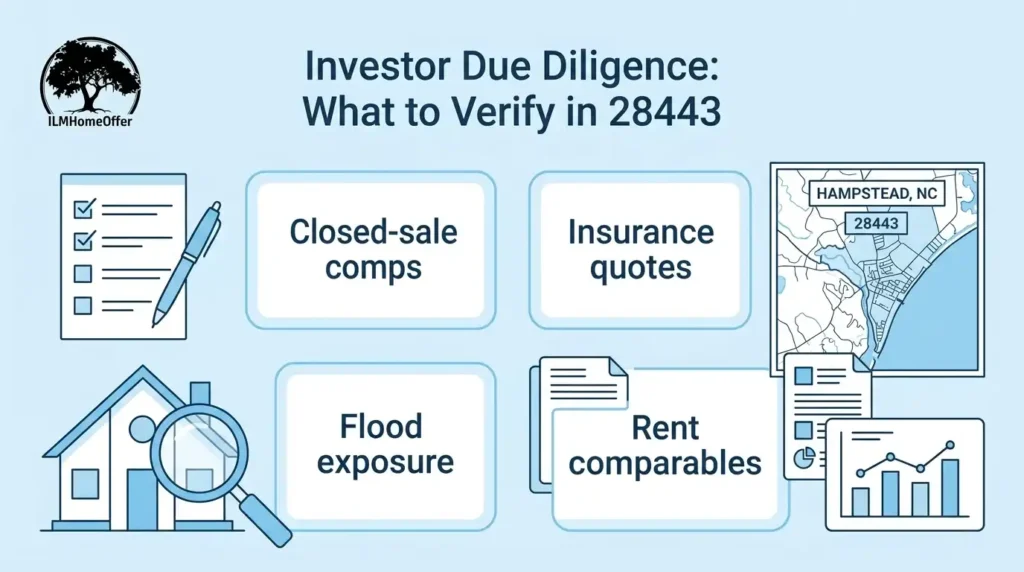
A flip can look profitable until the insurance quote, flood-zone review, repair scope, and financing terms turn a portal estimate into a much thinner deal. The direct answer is to underwrite Hampstead property by property, using current evidence for every major assumption instead of a market-wide shortcut.
A deal is only as strong as its least-tested assumption.
1. Establish closed-sale comps and ARV. Use recent, relevant completed sales and adjust for condition, location, size, features, and buyer appeal. Keep ARV separate from list prices and portal estimates.
2. Validate current rent comps. Compare actual available and recently leased rental alternatives where possible. HUD Fair Market Rent data are official program benchmarks, not substitutes for current property-specific Hampstead rent comparables.
3. Scope repairs. Separate cosmetic work from structural, systems, moisture, drainage, roof, and other conditions that can change the cost, timeline, financing, insurance, or resale outcome.
4. Verify taxes by parcel. Use current county records for a property-specific tax assumption. This guide does not supply a local tax rate or parcel tax conclusion.
5. Obtain insurance quotes. North Carolina guidance states that standard homeowners policies generally do not cover flood or rising-water damage, and flood coverage is separate. Coverage, eligibility, deductibles, and pricing remain property- and policy-specific — sellers facing this exact gap in coastal Pender County have had to navigate it too, as covered in selling a coastal NC home with rising flood insurance.
6. Review flood exposure at the address level. FEMA’s Flood Map Service Center is the official public source for flood-hazard information. Use the exact property address and supplement the review with applicable state and county resources.
7. Test wind and storm exposure within the full insurance review. Do not treat a general market narrative as a coverage conclusion for a specific address.
8. Compare financing terms on an equal basis. The CFPB advises comparing standardized Loan Estimates for the same loan type, term, and down-payment assumptions. Review interest rate, total monthly payment, loan costs, lender credits, cash to close, and five-year borrowing cost.
9. Model vacancy, holding, and selling costs. Include utilities, maintenance, financing, insurance, commissions, concessions, and the time required to reach the intended exit.
10. Test exit liquidity. Ask who the likely buyer or tenant is, what they will compare the property against, and what happens if the sale or lease takes longer than expected.
Definition: Underwriting is the process of testing a property’s income, cost, risk, financing, and exit assumptions before deciding whether the economics support an offer.
Demand Drivers and Risks Behind Hampstead Market Conditions
An investor can hear that coastal-area demand will carry every deal, then discover that the same model omitted supply, insurance, and exit-risk assumptions. A demand story is incomplete until it includes the costs and constraints that could weaken the investment case.
Every demand claim needs a matching risk test.
- If an investor sees buyer or tenant demand, test whether current inventory, price reductions, and days on market support the planned exit.
- If a property appears attractive because of its setting or buyer appeal, test insurance costs, flood exposure, storm-related considerations, maintenance needs, and the assumptions behind resale liquidity.
- If a local narrative suggests supply pressure, verify that claim with dated official planning, permitting, or other relevant evidence rather than repeating an unsupported construction total.
- If affordability is part of the thesis, test the purchase price, financing terms, insurance quote, property taxes, repair scope, and monthly operating costs together — and if the hold period stretches into a long-term rental play, factor in the eventual disposition, since strategies like those in the landlord’s exit strategy for avoiding capital gains tax on rental property in North Carolina can materially change net proceeds.
Definition: A market geography is the exact area a statistic represents, not a label that can be transferred automatically to a nearby boundary. Pender County, the Census-defined Hampstead place or CDP, and ZIP Code Tabulation Area 28443 are separate geographies for Census and ACS analysis. Use the relevant geography and vintage before drawing a demand conclusion, then state that geography clearly in the model.
A local market narrative is not evidence until the geography, date, and measure are visible.
How to Verify Hampstead Market Data When Portals Disagree
An investor can see different values for Hampstead across portals and decide not to choose the number that makes the deal work before matching geography, date, and metric definition. The direct answer is to verify the source hierarchy before using any market number in an offer, forecast, or marketing claim.
The right number is the one whose geography, date, and definition match the decision.
1. Identify the exact geography. State Hampstead, North Carolina or ZIP Code 28443 consistently. Do not confuse either with Hampstead, London, Pender County, or a Census-defined place.
2. Match metric definitions. Separate median listing price, median sold price, price per square foot, rent data, and ARV. They answer different questions.
3. Compare update dates. A June city-page scrape and a July ZIP Code 28443 retrieval should not be blended into one figure.
4. Prioritize completed-sale or MLS-level evidence where available. Use it for property-specific resale analysis, then document the comp criteria and adjustments.
5. Use listing portals as labeled context. They can show current asking-price, inventory, and market-time patterns, but they do not replace property-level due diligence.
6. Validate with official records and address-level research. Use county records, permitting resources, flood mapping, insurance quotes, rental comparables, and financing documentation for the assumptions they govern.
Definition: A metric spread is the difference between figures caused by different geographies, dates, definitions, or data methods. It does not automatically mean one portal is wrong. Realtor.com’s data documentation distinguishes listing-side measures and notes methodology changes affecting inventory and days-on-market comparability. That is why the June city-page snapshot and July 2026 ZIP Code 28443 snapshot should remain separate.
FAQs
What is the hottest real estate market in NC?
No single North Carolina market is objectively hottest for every investment strategy. A buy-and-hold operator, flipper, and wholesaler can reach different conclusions because acquisition price, rent or resale demand, competition, inventory, and the planned exit all change the economics. Evaluate the specific market and property against the strategy instead of relying on a statewide ranking.
Is Hampstead, NC expensive to live?
The July 2026 ZIP Code 28443 portal snapshot reported a median for-sale price of $495,500, which provides listing-side context rather than a full cost-of-living conclusion. Whether a household or investor experiences a property as expensive depends on the specific purchase price, financing, insurance, taxes, maintenance, rent assumptions, and exit plan. A ZIP-level listing metric is a starting point, not a complete affordability model.
Are houses in Hampstead expensive?
The answer depends on which price measure is being used. A listing price is an asking-price measure, a sold price records a completed transaction, and an estimate is a separate calculation. Realtor.com’s data documentation distinguishes listing-side measures from other market measures. For an investor, price alone does not establish deal quality because repairs, financing, insurance, rent, ARV, holding costs, and exit demand can materially change the result.
How long should investors monitor Hampstead market data before changing strategy?
Review a consistent monthly series rather than reacting to a single portal update. Deal-by-deal underwriting can change as soon as a current comp, insurance quote, repair finding, or financing term changes. Broader strategy changes should follow repeated evidence across the same geography and metric definitions, including inventory, days on market, price reductions, listing and sold-price measures kept separate, rent comparables, financing terms, and insurance costs. Metric definitions and methodology should remain consistent across the series.
Is localized investor marketing worth the investment in Hampstead?
Localized investor marketing is worth testing when the operator can define the target seller, market, offer, attribution window, and acceptable cost per qualified opportunity. Measure the work against closed economics, not traffic alone. The test should show whether the local message produces qualified conversations and whether those conversations progress to appointments, contracts, and closed deals under the operator’s actual acquisition standards.
Conclusion
Hampstead market research becomes useful when every number carries its geography, date, definition, and role in the deal model. Start with dated ZIP-level context, then validate the property through closed-sale comps, rent evidence, repair scope, insurance, flood review, financing, holding costs, and exit liquidity.