

If you own property in Wilmington, NC, you may be eyeing the short-term rental market as a way to generate steady income. Platforms like Airbnb and Vrbo have made hosting easier than ever — but Wilmington’s local regulations have kept pace with that growth. Before you list your first night, understanding the Wilmington short term rental rules is essential to staying legal, profitable, and neighbor-friendly.
The city has implemented a structured framework covering everything from zoning approval and occupancy caps to tax collection and safety inspections. Skipping any of these steps can result in fines, permit revocations, or forced delisting. This guide breaks down every requirement hosts need to meet in plain language, so you can make a fully informed decision before accepting your first reservation.
Wilmington’s appeal as a coastal destination makes it one of the more competitive STR markets in North Carolina. That popularity is also why the city has built guardrails around the industry. Whether you are buying an investment property or converting a spare bedroom, the rules apply equally and are actively enforced year-round.
If you are also weighing whether selling outright makes more financial sense than hosting, explore how cash buyers can simplify that decision at ILM Home Offer — selling your Wilmington as-is.
How Wilmington Defines a Short-Term Rental
Wilmington officially classifies a short-term rental (STR) as any residential dwelling rented for fewer than 30 consecutive days. This distinguishes STRs from traditional long-term leases, which fall under a separate regulatory framework. The definition applies to entire homes, single rooms, and accessory dwelling units rented on platforms or through private arrangements. Understanding this threshold is the first step before pursuing any permit application.
The 30-day rule is a hard line — a guest who stays 29 nights triggers every STR obligation, while a 30-night stay does not. Hosts who routinely mix short and long stays on the same property must track each booking separately to determine which regulatory tier applies. Keeping accurate records protects you during any audit or compliance review.
| Rental Type | Duration | Regulated As |
| Short-Term Rental | Fewer than 30 nights | STR — city permit required |
| Mid-Term Rental | 30-90 nights | Standard lease rules apply |
| Long-Term Rental | 90+ nights | Residential landlord-tenant law |
Zoning Requirements for Wilmington Short-Term Rentals
Not every property in Wilmington is eligible to operate as a short-term rental. The city’s zoning ordinance governs which districts allow STR activity and under what conditions. Residential zones such as R-1, R-2, and R-3 permit owner-occupied STRs in most cases, while some commercial zones allow non-owner-occupied rentals. Confirming your parcel’s zoning classification with the Planning and Development Department is a mandatory first step.
Wilmington distinguishes between two operational categories: hosted and non-hosted rentals. Hosted rentals require the owner to be present on-site during guest stays, while non-hosted rentals allow full-property rentals during the owner’s absence. Each category carries different zoning permissions and compliance requirements that shape everything from permit eligibility to allowable guest counts.
Key zoning rules to know include:
● Owner-occupied requirement: Non-hosted STRs face stricter zoning limits and may not be allowed in all residential districts.
● Adjacent use restrictions: Properties within 500 feet of another permitted STR may be denied a new permit in some zones.
● Accessory dwelling units (ADUs): ADUs are eligible for STR permits in most zones if the primary dwelling is owner-occupied.
● Commercial zone STRs: Permitted in specific B-1 and B-2 zones but subject to additional fire and safety code compliance.
If your parcel sits in a historic district or overlay zone where STR approval is unlikely, reviewing your exit options is a practical step. Learn how homeowners in restricted zones have found value through how we buy houses at ILM Home Offer. Zoning classifications can change with new development plans, so confirming your current status annually is good practice.
Permitting Process: What You Need to Apply
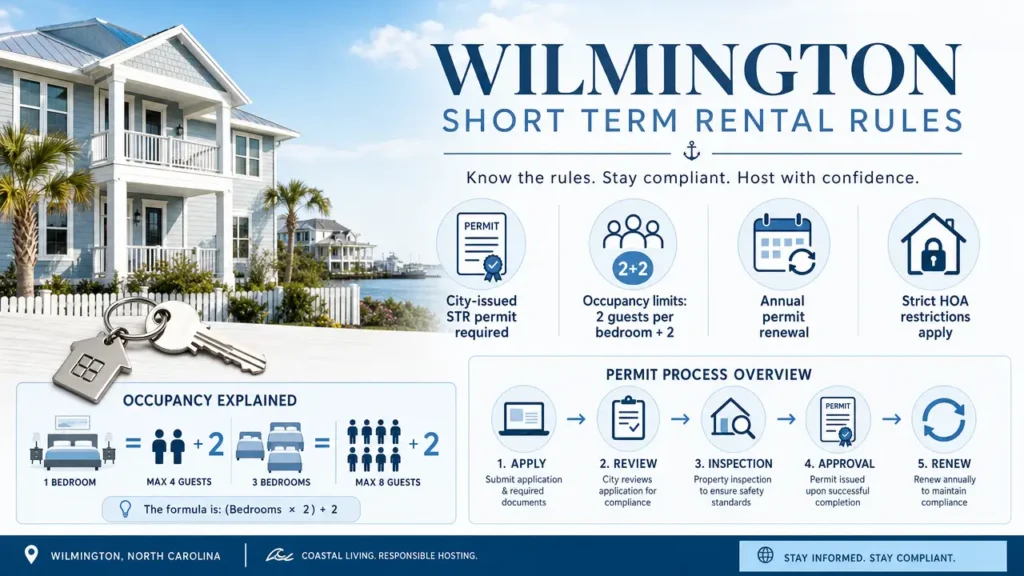
All short-term rental operators in Wilmington must obtain a city-issued STR permit before accepting any bookings. The application process is handled through the Wilmington Inspections department and requires submitting documentation that proves ownership, habitability, and compliance with local codes. Permits must be renewed annually, and failure to renew before the expiration date can result in a lapse penalty. Processing typically takes two to four weeks for complete applications.
The city has moved most of the application process online through its Development Services portal, which allows hosts to upload documentation, track application status, and receive electronic approval. Paper applications are still accepted in person at City Hall but generally take longer to process. Having all required documents ready before you begin reduces back-and-forth delays significantly.
To apply for an STR permit in Wilmington, you will need:
● Proof of property ownership (deed or tax record)
● Completed STR permit application from the City of Wilmington Development Services portal
● A site plan or floor plan showing the rental unit and parking availability
● Proof of homeowner’s or landlord’s insurance with minimum $300,000 liability coverage
● Signed acknowledgment of Wilmington’s short-term rental regulations and neighbor notification requirements
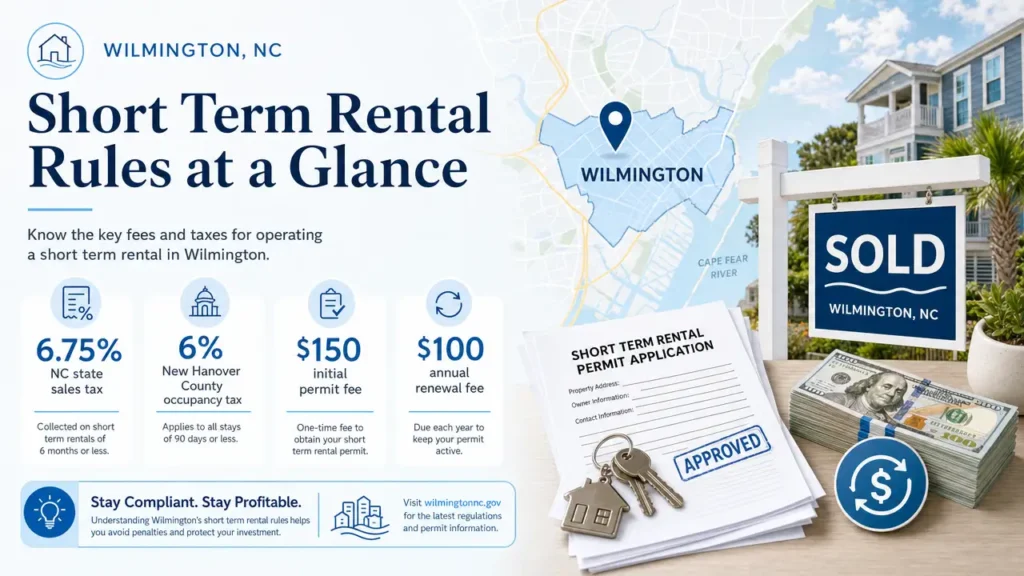
● Payment of the non-refundable permit fee ($150 for initial application; $100 for annual renewal)
Once issued, the STR permit number must be displayed on all listing platforms, printed guest materials, and any advertising. The city conducts randomized compliance checks on active listings to verify this disclosure. Permits are non-transferable — if you sell your property, the new owner must apply for a fresh permit before continuing to operate.
Occupancy Limits and Property Safety Standards
Wilmington enforces strict occupancy limits tied to bedroom count and square footage to prevent overcrowding in residential neighborhoods. The standard rule caps guests at two per bedroom plus two additional guests per unit overall. For example, a three-bedroom home can accommodate a maximum of eight guests under this formula. Hosts must clearly state maximum occupancy in their listing and in every rental agreement they issue.
Safety standards that apply to all permitted STRs include:
● Smoke and carbon monoxide detectors: Required in every sleeping room and in the hallway directly adjacent to sleeping areas.
● Fire extinguisher: At minimum, one 2A:10BC extinguisher must be accessible in or near the kitchen area.
● Emergency exit map: Must be posted visibly near the primary entrance and in each sleeping room.
● Pool and hot tub fencing: Pools must comply with NC residential pool barrier code, including self-latching gates at least 48 inches high.
● Parking: A minimum of one off-street parking space per bedroom is required in most residential zones to avoid street congestion.
Beyond the city’s baseline standards, it is good practice to install keyless entry locks, provide emergency contact information prominently, and conduct a safety walkthrough between every guest stay. These habits not only protect guests but also reduce the likelihood of complaints that could trigger an inspection. Hosts with properties in flood-prone areas near the Cape Fear River should also provide evacuation information as part of the standard welcome materials.
These safety rules align closely with the state-level requirements outlined by the North Carolina Building Code Council. Hosts should review both city and state standards to ensure full compliance.
Taxes Every Wilmington STR Host Must Collect
Operating a short-term rental in Wilmington means you are legally required to collect and remit several layers of tax. North Carolina imposes a 6.75% state sales tax on short-term lodging, and New Hanover County adds a 6% occupancy tax on top of that. Most major booking platforms automatically collect and remit these taxes on behalf of hosts — but direct bookings or co-hosted arrangements may leave that responsibility with you. Confirm your platform’s tax remittance policy before assuming the obligation is covered.
Hosts who manage bookings through multiple channels — combining Airbnb, Vrbo, and direct reservations — face a more complex tax picture. Taxes collected by a platform are documented in the platform’s transaction history and should be reconciled against your own records quarterly. Any discrepancy in remitted amounts is your legal responsibility to correct, even if the error originated with the platform.
| Tax Type | Rate | Remitting Authority |
| NC State Sales Tax | 6.75% | NC Department of Revenue |
| New Hanover County Occupancy Tax | 6% | New Hanover County Tax Department |
| City of Wilmington Business Tax | Flat annual fee | City of Wilmington Revenue Division |
Hosts who collect taxes directly must register with the North Carolina Department of Revenue and file returns on a monthly or quarterly basis depending on gross receipts. Non-compliance carries penalties of up to 25% of unpaid tax plus interest. Setting up a dedicated bank account for tax reserves from day one is one of the most effective ways to avoid a shortfall when quarterly deadlines arrive.
HOA Rules and Lease Restrictions That Can Override City Permits
Even with a valid city STR permit, hosts can still be blocked from operating if their homeowners’ association (HOA) prohibits short-term rentals. Wilmington has several master-planned communities and condominium complexes — such as Landfall and Riverlights — where CC&Rs explicitly ban rentals under 30 days. Violating HOA rules can result in fines from the association, suspension of amenity access, or even legal action independent of the city. Always review your HOA’s governing documents before applying for an STR permit.
HOA restrictions have become increasingly common as communities respond to the growth of vacation rental platforms in residential neighborhoods. Some associations have amended their CC&Rs in recent years to close loopholes that previously allowed short-term rentals under vague language. If your HOA documents are dated, request an updated copy from the association’s property manager before making any hosting plans.
If you are renting rather than owning, additional restrictions apply:
● Your lease agreement must explicitly permit subletting or short-term rentals — silent leases typically default to prohibition
● Landlord written consent is typically required and should be obtained in writing before submitting any permit application
● Lease violations for unauthorized subletting can result in eviction regardless of whether the city has issued you a valid permit
For owners in deed-restricted communities who cannot legally operate a short-term rental, selling the property outright may be a more practical path to returns. Learn more about your options at how to sell a property with HOA complications in Wilmington.
Violations, Fines, and How Wilmington Enforces STR Rules
Wilmington takes code enforcement seriously and has a complaint-based system supplemented by proactive platform monitoring. Neighbors, guests, or anonymous tipsters can file complaints through the city’s online portal, triggering an inspection within five business days. First-time violations typically result in a notice of correction with a 30-day cure window, while repeat or egregious violations can lead to immediate permit revocation. Fines for operating without a permit start at $500 per day of unlicensed activity.
The city’s code enforcement team cross-references active STR listings against the permit registry on a regular basis. Properties that appear on Airbnb or Vrbo without a matching city permit number are flagged for review. Hosts who receive a flag but correct the issue before an inspector visits may avoid formal fines, but the flag itself is recorded and increases scrutiny on future reviews.
| Violation Type | First Offense | Repeat Offense |
| Operating without a permit | $500/day | Permit denial for 1 year |
| Exceeding occupancy limits | $250 fine + correction notice | $500 + escalated review |
| Noise / nuisance complaints | Warning + 30-day cure | Permit suspension or revocation |
| Failure to post permit number | $100 administrative fee | $250 + compliance audit |
Platforms like Airbnb cooperate with Wilmington’s code enforcement team under platform partnership agreements that allow the city to request listing removal for non-compliant hosts. Review current enforcement protocols on the City of Wilmington Development Services page.
Bottomline: Short-Term Rental Rules
Wilmington’s short term rental rules are thorough by design — the city wants to balance economic opportunity for hosts with quality-of-life protections for permanent residents. Getting compliant requires navigating zoning approvals, permit applications, tax registrations, and safety inspections before accepting a single guest. But hosts who follow the framework can operate confidently in one of North Carolina’s most attractive coastal rental markets.
The permit and tax compliance process is manageable once you have a clear checklist and timeline. Most hosts who face enforcement issues do so not from ignorance of the major rules but from letting permits lapse, failing to update listings with permit numbers, or overlooking direct booking tax obligations. Building a simple annual compliance calendar prevents the most common and costly mistakes.
If the regulatory complexity, HOA restrictions, or the ongoing management burden makes hosting impractical for your property, selling may be the smarter financial move. Cash buyers specializing in Wilmington real estate can close quickly without the delays and contingencies of a traditional listing.
FAQs: Wilmington Short-Term Rental Rules
Do I need a permit to rent my property on Airbnb in Wilmington, NC?
Yes. All short-term rentals in Wilmington require a city-issued STR permit before accepting bookings. You must apply through Development Services, pay the permit fee, and display your permit number on all listings. Fines for operating without a permit start at $500 per day.
How much does a Wilmington STR permit cost?
The initial application fee is $150. Annual renewals cost $100. Additional fees may apply if your property requires a code compliance inspection before approval is granted.
Can I rent a room in my house short-term while I live there?
Yes, hosted short-term rentals — where the owner is present on-site — are permitted in most residential zones. You still need a city permit, and standard occupancy limits and safety requirements apply to any rented room or shared space.
Does Airbnb collect the occupancy tax for Wilmington hosts?
Airbnb automatically collects and remits North Carolina sales tax and New Hanover County occupancy tax for platform bookings. For direct reservations, hosts are personally responsible for collecting and remitting all applicable taxes to the relevant authorities.
What happens if my HOA prohibits short-term rentals?
HOA rules override city permits. If your CC&Rs ban STRs under 30 days, you cannot legally operate even with a valid city permit. Violations can trigger HOA fines and legal action entirely separate from any city enforcement proceedings.
Is it worth hosting short-term rentals in Wilmington, or should I sell instead?
It depends on your financial goals, zoning eligibility, and HOA constraints. STRs can yield strong seasonal returns, but compliance costs and restrictions may limit profitability. Compare your options at ILM Home Offer — how we buy houses.
Final Thoughts: Navigating Wilmington’s STR Regulations
Learn more about what to expect when selling your Wilmington home fast at the ILM Home Offer blog. For the latest on North Carolina’s statewide lodging tax regulations, the NC Department of Revenue sales and use tax page is the authoritative reference. Additional compliance guidance for hosts is available through the Airbnb Responsible Hosting guide for North Carolina.
The rental landscape in Wilmington will continue to evolve as the city monitors STR density and community impact on residential neighborhoods. Staying current with annual permit renewals, reviewing your HOA documents regularly, and keeping your tax registrations up to date are the three habits that separate compliant, profitable hosts from those who face enforcement actions. Whether you choose to host or sell, knowing your options gives you full control over what your Wilmington property can deliver for your financial future.