

If you own a vacant, inherited, or long-distance rental property in Wilmington and you just discovered unauthorized occupants, your first instinct is panic. You are probably searching squatters rights North Carolina and wondering whether these people now have a legal claim to your home. The short answer: no — not yet, and likely not ever if you act promptly.
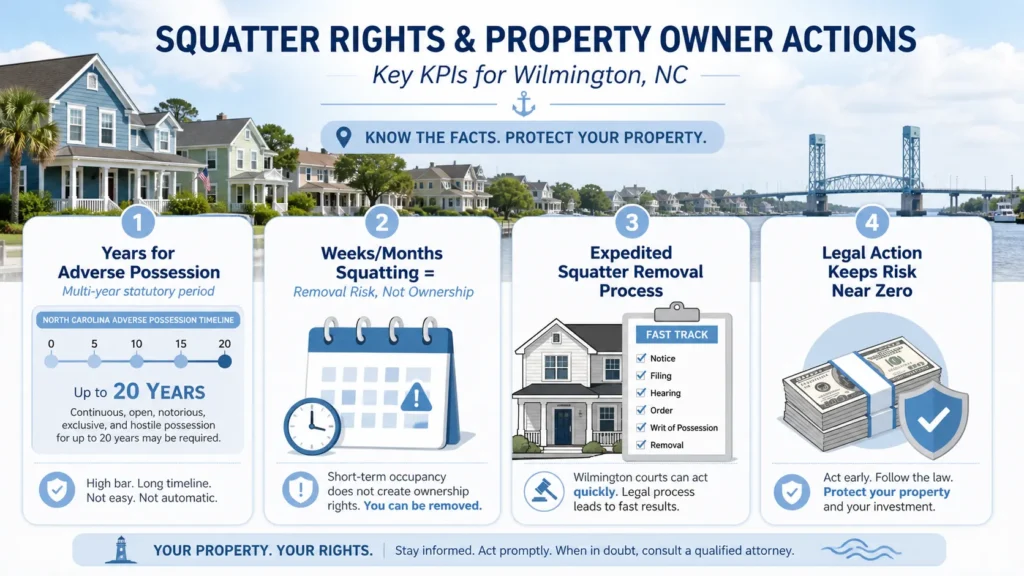
North Carolina law requires years of uninterrupted, open, owner-like possession before anyone can convert unauthorized living into a legal ownership claim. A few weeks or months of squatting creates a removal problem, not a deed problem. Acting quickly — with law enforcement and a licensed attorney — keeps your risk near zero.
This guide explains how North Carolina adverse possession rules work, how to classify who is actually in your property, the legal steps to remove them, and when selling as-is to a Wilmington cash buyer is a smarter exit than years of ongoing legal exposure and vacancy costs.
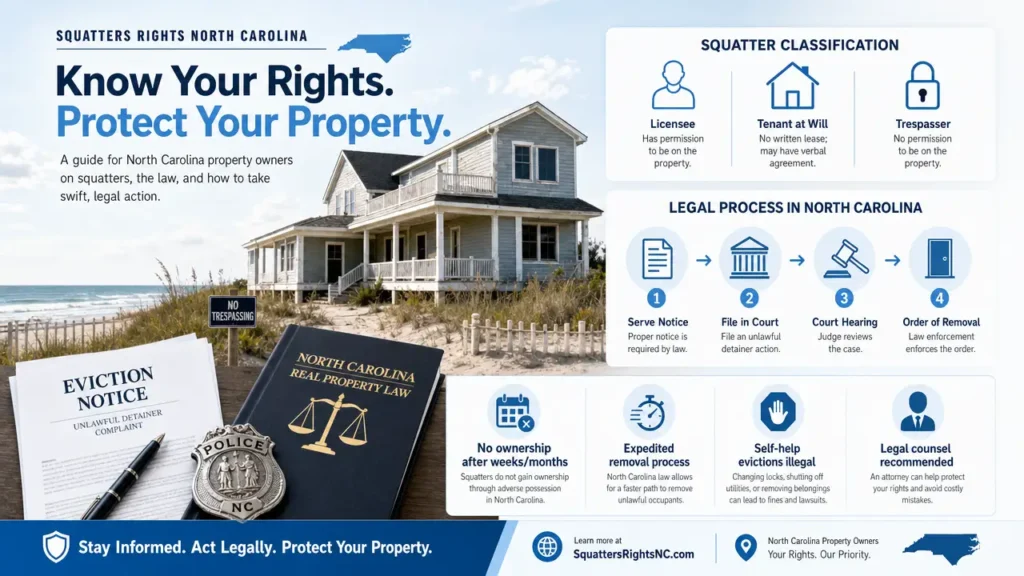
Squatter, Trespasser, or Holdover Tenant — Why the Label Matters
Getting the classification right is the single most important first step for any Wilmington owner dealing with unauthorized occupants. North Carolina law routes each occupant type through a completely different legal process, and filing the wrong paperwork wastes time, money, and judicial goodwill.
A squatter is someone living in your property with no lease, no ownership interest, and no express permission — ever. A trespasser is broadly similar but typically has no ongoing claim to stay; think a one-time break-in versus someone who has moved furniture in. A holdover tenant once had a valid lease and your express permission, but stayed beyond the lease end date without a signed renewal.
| Occupant Type | Prior Permission? | Lease on File? | Primary Legal Path |
| Squatter | No | No | Expedited squatter removal or criminal trespass |
| Trespasser | No | No | Law enforcement / criminal trespass complaint |
| Holdover Tenant | Yes (historically) | Yes, now expired | Summary ejectment — standard NC eviction process |
Choosing the wrong lane slows everything down. An attorney may need to redirect a misfiled eviction into a squatter-removal case, adding weeks of delay and additional filing fees.
• Confirm the occupant type before filing any paperwork
• Gather all lease records, communications, and payment history first
• Consult a licensed North Carolina real estate or landlord-tenant attorney before taking any legal action

How North Carolina Adverse Possession Law Actually Works
Adverse possession is the legal doctrine that lets someone petition a court for ownership of land they do not hold title to, after occupying it under specific conditions for a multi-year statutory period defined in North Carolina law. For most Wilmington owners, it is less of an immediate threat and more of a long-term risk that vigilance and prompt action eliminates entirely.
North Carolina courts require all five elements below to be proven simultaneously and continuously throughout the full statutory period. A claimant who fails even one element cannot succeed. For the governing statutes, review Justia’s North Carolina adverse possession statutes directly.
| Element | Plain-English Definition |
| Actual possession | Physically using and occupying the land — not just claiming it on paper |
| Open and notorious | Use is visible to neighbors and to the true owner; nothing concealed |
| Exclusive | Claimant controls the land alone — not jointly with the true owner |
| Continuous (multi-year) | Unbroken occupation for the full statutory period set by NC law |
| Hostile / adverse | Without the owner’s permission, directly contradicting their rights |
Color of title — a deed that looks valid but is legally flawed — can affect how a court weighs a claim and may interact with certain statutory timeframes, but it does not replace all five elements above. Paying property taxes is treated as evidence of owner-like behavior, not a standalone ownership trigger. A group inside your Wilmington property for weeks or a few months is nowhere near the multi-year threshold.
The financial cost of letting a vacant property sit while legal issues drag on is real — unpaid taxes compound, insurance lapses, and structural issues worsen. For context, read ILM’s overview of property taxes in Wilmington NC to understand what prolonged vacancy actually costs.
North Carolina’s Expedited Process to Remove Squatters
North Carolina has a dedicated expedited court path for true squatter removal — occupants with no lease, no rental history, and no legitimate legal argument for being in the property. It moves faster than a full summary-ejectment eviction and is separate from standard landlord-tenant law.
The key qualifier is critical: there must be no prior landlord-tenant relationship. The moment rent was ever paid and accepted, courts typically redirect the case into the standard summary-ejectment track. When facts confirm a true squatter, here is the general sequence for a Wilmington owner.
• Gather your documentation first. Collect your deed, any lease records confirming no tenancy exists, all communications with or about the occupants, and police incident report numbers. This paper trail is what your attorney files on.
• Engage a North Carolina attorney immediately. The expedited path has specific filing requirements. Use the NC State Bar find-a-lawyer directory to find qualified counsel in New Hanover County.
• File in the county where the property sits. For Wilmington properties, that is typically New Hanover County court. Your attorney files the squatter-removal petition under current NC law.
• The sheriff serves formal notice. After filing, the sheriff serves occupants with notice of the hearing date. They retain the right to respond and appear before the magistrate.
• Attend the magistrate hearing. A magistrate or judge reviews both sides and rules on whether the occupants qualify as unauthorized squatters under North Carolina statutes.
• Sheriff executes the removal. If the court rules in your favor, the sheriff schedules and carries out physical removal of any occupants who do not voluntarily vacate.
For the most current version of NC squatter-removal statutes, verify directly with the North Carolina General Assembly’s official legislative site before filing anything. Procedures evolve, and your attorney should always confirm the latest requirements before submitting paperwork.
Self-Help Evictions Are Illegal in North Carolina
The temptation to take matters into your own hands is understandable — especially if you live out of state and just found out strangers are inside your Wilmington property. North Carolina law is unambiguous: property owners cannot use self-help tactics to remove occupants, regardless of how unauthorized their presence is. Violating this rule exposes you to civil liability and can actively damage your court case.
If you believe there is immediate danger — weapons, drugs, or active violence — call 911. For non-emergency situations, contact the Wilmington Police Department non-emergency line and let officers assess the scene before you enter the property yourself.
• Do NOT change the locks while occupants are still inside the property
• Do NOT cut off water, electricity, gas, or other utilities to force occupants out
• Do NOT remove doors, windows, or fixtures to make the property uninhabitable
• Do NOT dispose of or move occupants’ belongings without a court order in hand
• Do NOT confront occupants directly, particularly at night or without law enforcement present
Documentation is your most powerful legal tool at this stage. Dated photos and videos, copies of all leases and rent ledgers, saved text and email communications, and police report numbers all support your attorney’s filing. The UNC School of Government publishes plain-language guides on North Carolina landlord-tenant law that clarify exactly what actions are and are not permitted for property owners.
Preventing Squatters in Wilmington’s Coastal Rental Market
Wilmington’s coastal and tourism-heavy neighborhoods — Carolina Beach, Wrightsville Beach, and downtown — carry above-average squatter risk because properties sit vacant between rental seasons and many owners live hours away. Prevention costs far less than removal in both time and money.
The most effective prevention approach combines physical deterrence, regular monitoring, and proper documentation of any informal permission arrangements. Each of the following steps directly reduces the likelihood of an unauthorized occupancy taking root.
• Put every temporary permission in writing. Housesitters, caretakers, and short-term guests should sign a simple written agreement with clear start and end dates. An expired written agreement is far easier to enforce than a verbal one.
• Schedule regular physical inspections. A local property manager or trusted neighbor who does monthly walkthroughs and post-storm checks provides early warning before a squatter situation becomes entrenched.
• Install visible security measures. Motion-activated exterior lighting and a basic camera system at entry points signal active monitoring. Opportunistic squatters typically move to easier targets.
• Maintain the exterior actively. Overgrown grass, piled-up mail, and dark windows signal that no one is watching. Regular lawn care and minimal active utilities prevent the abandoned-property appearance.
• Post no-trespassing notices. Where local ordinances permit, clearly posted signage gives law enforcement stronger footing to treat an intruder as a criminal trespasser rather than a potential civil matter.
For owners who have concluded that managing a vacant Wilmington property from a distance is no longer viable, ILM Home Offer’s guide on how long does it take to sell a home in Wilmington covers all available options in plain terms, without pressure or obligation.
When a Cash Sale Makes More Sense Than Prolonged Legal Battles
Once the legal process is underway, many Wilmington owners reach an honest crossroads: is this property still worth holding? Inherited homes and long-vacant rentals often cost more to carry — in taxes, insurance, maintenance, and attorney fees — than they return in rent or future appreciation.
A traditional sale after a squatter situation carries real friction. Most retail buyers and their lenders are cautious about properties with eviction history or deferred maintenance, and that caution translates into longer timelines, contingency-heavy contracts, and renegotiated prices at the finish line.
| Sale Path | Typical Timeline | Repair Required? | Lender Involved? |
| Agent listing (post-eviction) | 3 – 6+ months | Yes — market-ready standard | Yes — buyer’s mortgage approval needed |
| Cash buyer (as-is) | 2 – 4 weeks | None — condition priced into offer | No — funded with buyer’s own capital |
ILM Home Offer buys properties throughout Wilmington and coastal North Carolina as-is, with no repairs, no agent commissions, and no closing costs charged to the seller. They issue a written cash offer within 48 hours of a property walkthrough and structure closing around whatever court-ordered removal date your attorney has in place. They also buy tenant-occupied properties with no eviction required before closing.
If your situation involves overlapping foreclosure timelines as well, ILM’s resource on selling a house in foreclosure in NC explains how both issues can be managed in parallel without one derailing the other process. No two situations are identical, but a cash buyer who understands Wilmington’s coastal market can work around the complications that stop traditional buyers entirely.
Who to Call First — and in What Order
When you discover unauthorized occupants in your Wilmington property, the sequence of your calls matters as much as who you call. Moving in the wrong order — for example, engaging a buyer before you have legal clarity — creates unrealistic timelines and leaves you exposed.
Start with law enforcement for any situation involving safety risk, active break-in, or immediately dangerous conditions. Use 911 for emergencies and the non-emergency line for serious but stable situations. Always request a police report number regardless of what officers can or cannot do on the scene.
Next, contact a North Carolina real estate or landlord-tenant attorney. They confirm the occupant classification, choose the correct court process, and handle all filings. The NC Judicial Branch website provides official court forms and procedural guidance worth reviewing before your first attorney consultation.
1. Law enforcement — safety assessment, scene documentation, police report number
2. Licensed NC attorney — occupant classification, correct legal path, court filings
3. Local cash buyer — financial exit strategy once legal roadmap and timeline are confirmed
ILM Home Offer can work alongside your attorney’s process and have a cash offer ready the moment legal clearance is achievable. For a broader overview of how ILM structures purchases around legal and practical complications, visit ILM’s blog on selling your Wilmington home fast.
FAQs: Squatters Rights North Carolina
How long does someone need to occupy property to claim squatter’s rights in North Carolina?
North Carolina requires many continuous years of open, exclusive, hostile possession — a multi-year statutory period defined in state law. Weeks or months of unauthorized occupancy do not create any ownership claim. Prompt legal action keeps adverse possession risk near zero.
Can I change the locks to force a squatter out?
No. Self-help evictions — including lock changes, utility shutoffs, or removing belongings without a court order — are illegal in North Carolina and expose you to civil liability. Use the expedited squatter-removal court process with an attorney instead.
What is the difference between a squatter and a holdover tenant in NC?
A squatter never had permission or a lease; a holdover tenant had both but stayed after the lease expired. That distinction determines your legal path: expedited squatter removal for true squatters, summary ejectment (standard eviction) for holdover tenants.
Does paying property taxes give someone squatter’s rights in NC?
No. Tax payments are evidence of owner-like behavior, not a standalone ownership trigger. All five adverse-possession elements must be proven continuously over a multi-year statutory period. Paying a few tax bills alone cannot transfer title under North Carolina law.
Can I sell my Wilmington home as-is after a squatter situation?
Yes, once legal clearance is in place. Cash buyers like ILM Home Offer assess current condition and legal status without requiring a market-ready repair list. No agent, no lender approval, and no renovation project is needed to receive a written cash offer.
What if I am facing both squatters and foreclosure at the same time?
Both can be managed in parallel. A North Carolina attorney handles occupant removal while a cash buyer structures closing around the bank’s foreclosure timeline. ILM Home Offer regularly coordinates purchases that address both issues simultaneously.
Squatters rights in North Carolina are governed by multi-year legal thresholds that most short-term unauthorized occupants will never approach. Your most important asset right now is time: the earlier you engage law enforcement, an attorney, and — if you decide to sell — a local cash buyer, the more control you retain over the final outcome.
If you are ready to explore a no-obligation offer on a Wilmington property that has become more burden than asset, ILM Home Offer is ready to walk the property and deliver a written cash offer within 48 hours.
This article is educational information only and is not legal advice. Consult a licensed North Carolina real estate or landlord-tenant attorney for guidance specific to your situation.