
You open your renewal letter in Wilmington and the premium has jumped. Wind coverage seems to be part of the reason. You wonder whether one hard hurricane could leave a bill you cannot comfortably pay. Insurance should never be a surprise you meet during a storm.
NC wind pool insurance is the common shorthand for separate wind and hail coverage on coastal North Carolina property. It matters most when a standard homeowners policy limits or excludes wind. Your actual policy, your lender, and a licensed agent decide the details. Coastal owners often discover this gap only after a storm.
This guide covers what to ask, how wind coverage fits with your homeowners policy, and what drives cost. It also shows when insurance pressure may justify selling a storm-exposed Wilmington property. This is general information, not legal, tax, financial, or insurance advice.
What Is NC Wind Pool Insurance?
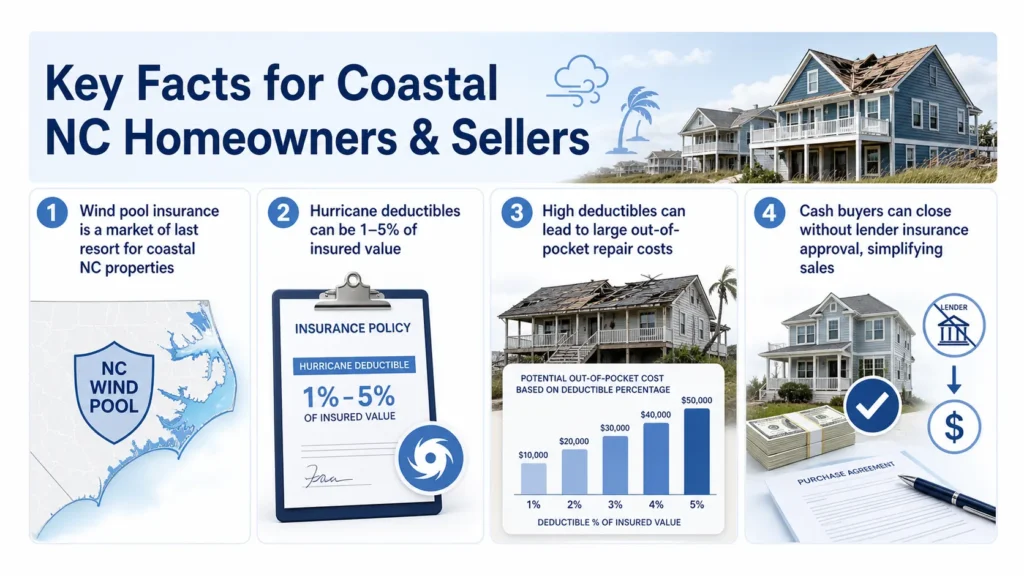
In North Carolina, wind pool coverage usually means the Coastal Property Insurance Pool, formerly called the Beach Plan. The North Carolina Insurance Underwriting Association runs it as a market of last resort for coastal property. It is not a state government facility, and the Insurance Commissioner reviews its plan of operation.
The pool offers homeowner, dwelling windstorm and hail, and homeowner windstorm and hail policies. These are available for eligible coastal counties. Your agent can place coverage either in the standard market or in the pool. Ask which specific form applies to your property.
The pool’s legal framework appears in G.S. Chapter 58, Article 45. That statute calls the pool the market of last resort for beach and coastal areas. Treat it as background, and confirm your own eligibility with an agent.
| Term | Plain-English meaning |
| Coastal Property Insurance Pool | The formal name for the former Beach Plan |
| Windstorm and hail policy | Coverage for wind damage when a standard policy limits or excludes it |
| Market of last resort | Coverage for owners who cannot find standard-market insurance |
| Declarations page | The policy summary listing coverages, limits, exclusions, and deductibles |
Why does this matter for Wilmington owners? Wind damage is the most common storm worry on the coast. Many owners assume their homeowners policy handles it fully. The pool exists because some coastal owners cannot find standard coverage, and others find it only at a steep price.
Common surprises include:
- A separate wind or hurricane deductible
- Wind coverage placed in a different policy
- Exclusions for rain entering through storm openings
- Lender demands for proof of wind coverage
Understanding this vocabulary first helps you ask sharper questions. Agents use these terms daily, and your paperwork assumes you know them. Keep the table handy when you read your renewal letter.
Where Wind Pool Coverage Applies Around Wilmington
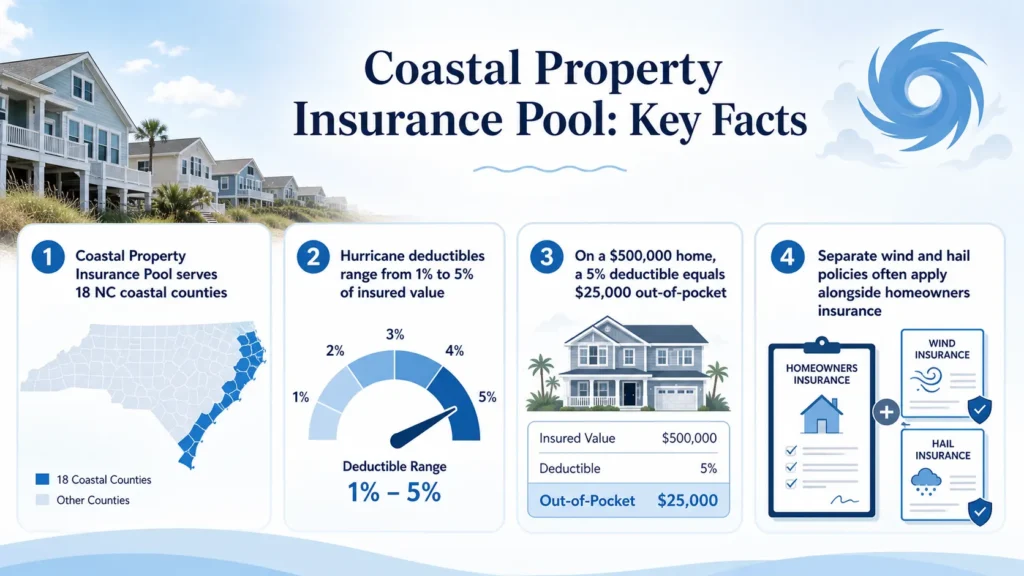
Eligibility is address-specific, not a simple statewide rule. The pool serves eligible beach and coastal territories across 18 North Carolina counties. Wilmington-area owners should confirm how their exact address is classified. Ask for that classification in writing.
Do not guess based only on distance to the beach. Two nearby properties can face different options, deductibles, and underwriting outcomes. Owners near Carolina Beach, Kure Beach, and river-adjacent neighborhoods often hear about coastal wind concerns.
The North Carolina Department of Insurance recommends trying the standard market before the pool. Start with your declarations page, then ask your agent these questions:
- Does my homeowners policy include wind and hail coverage?
- Is a separate windstorm policy tied to this property?
- Is my wind deductible different from my regular deductible?
- Do my lender or HOA require specific wind coverage?
Local conditions shape the answer. Older coastal bungalows, waterfront rentals, and homes near the Intracoastal Waterway face different wind exposure. Roof condition and construction details often matter as much as location. Factors that influence your exposure include:
- Elevation and flood zone
- Roof age and roof covering
- Window and door protection
- Distance to open water
Limited or costly coverage does not automatically mean you should sell. It does mean insurance belongs in your hold-versus-sell math. Slow down, confirm what you have, and compare cost against repair exposure. A second opinion from another agent can reveal options you missed.
Document your findings in one folder. Include quotes, emails, and agent names. This record helps if you later sell or file a claim.
How Wind Pool Works With Your Standard Homeowners Policy
Some coastal owners hold a base homeowners policy plus separate windstorm and hail coverage. The base policy may handle non-wind risks. The wind policy addresses storm-related wind damage. The exact split depends on policy forms, endorsements, and the facts of the claim.
Imagine a rental near Wrightsville Beach after a hurricane. Shingles are missing, windows are broken, and rain has entered the home. The owner must separate wind damage from water damage.
Flood is a separate question. FEMA’s FloodSmart program notes that most homeowners insurance does not cover flood damage. Rising water usually requires its own flood policy.
| Damage type | Usually addressed by | What to confirm |
| Wind and hail damage | Homeowners or windstorm policy | Exclusions and wind deductible |
| Rising water or storm surge | Separate flood policy | Whether a flood policy exists |
| Rain entering through wind openings | Depends on policy wording | Wind-driven rain terms |
| Wear, tear, and maintenance | Usually not covered | Roof age and condition |
| Personal belongings and outbuildings | Often limited or listed separately | Sublimits and scheduled items |
After a loss, adjusters sort damage by cause. Keep photos, receipts, and dated notes for every repair. Report the claim quickly, and keep damaged materials until an inspection is complete.
The deductible deserves special attention before storm season. A wind or hail deductible can differ sharply from the all-perils deductible you remember. Ask your agent to translate it into dollars for your property. Storm season is the wrong time to read policy language for the first time.
Separate policies can mean:
- Different definitions and exclusions
- Different deductibles
- More paperwork after a claim
- Uncertainty about what you pay before insurance helps
A large deductible turns storm damage into an out-of-pocket repair bill. That money comes from the same pocket as your future sale proceeds. Already hit by water? Read our guide on selling a house with water damage in NC.
Is NC Wind Pool Insurance Required?
No source supports a blanket rule that every North Carolina homeowner must carry wind pool coverage. Requirements usually come from your mortgage, HOA, and policy terms. Check those documents first.
Eligibility depends on address, structure type, and underwriting rules. Do not rely on a neighbor’s policy or an old quote. Each property is reviewed on its own facts.
Requirements often originate in these places:
- Mortgage or lender insurance clauses
- HOA or condo association rules
- Closing requirements for buyers
- Your insurer’s underwriting guidelines
A buyer without acceptable proof of coverage can see a financed closing delayed. A lapse in required coverage creates stress when a lender demands proof of insurance. These are contractual issues, so talk with your lender, HOA, attorney, and agent.
Before a closing or renewal, gather these documents:
- Current declarations page and policy forms
- Mortgage insurance requirements
- HOA or condo insurance rules
- Any flood policy declarations
Starting early gives you time to fix gaps before a closing deadline. If coverage is a problem, your options include:
- Shopping another agent or carrier
- Adjusting the deductible after weighing the risk
- Adding or adjusting a flood policy
- Comparing the option of selling as-is
Rentals and inherited homes can face different underwriting than owner-occupied houses. A duplex or vacation rental may not be treated like your primary residence. Ask your agent how your property type changes the answer. Request any coverage requirements in writing, and keep copies with your closing documents.
What Drives NC Wind Pool Insurance Costs?
Premiums and deductibles depend on your exact property, so no honest article can quote a number. A licensed agent must price your home. Quotes vary by carrier, so compare more than one. Use the factors below to prepare better questions.
Percentage deductibles deserve special attention on coastal wind coverage. Insurance Information Institute figures reported by CBS News put hurricane deductibles at 1 to 5 percent of insured value. On a $500,000 home, a 5 percent deductible means the first $25,000 is yours.
Mitigation features can also matter. Roof upgrades, shutters, and impact-rated windows may earn credits with some insurers. Ask what documentation your agent needs.
| Cost factor | Why it matters |
| Location and coastal classification | Drives eligibility and pricing |
| Distance to water and elevation | Raises storm exposure |
| Roof age and shape | Affects wind vulnerability |
| Construction type and building age | Changes underwriting outcomes |
| Claims history | Can raise premiums |
| Deductible structure | Trades lower premium for higher repair risk |
A higher deductible may lower your annual premium. It also leaves you with a bigger repair bill after a storm. For a rental with tight cash flow, that trade-off is serious.
Compare quotes by structure, not just price:
- Coverage limits
- Exclusions
- The wind deductible in dollars
- What you could realistically afford after a claim
The better question is what you keep after premiums, deductibles, taxes, and repairs. Our guide to property taxes in Wilmington, NC covers another recurring cost. Compare the full carrying-cost picture before deciding.
Request written quotes from at least two agents. Ask each to show deductibles in dollars, not only percentages. Keep the comparison in one simple spreadsheet. Recheck coverage every renewal, because underwriting rules and pricing can change.
Premium is only one line in your budget. Taxes, maintenance, vacancy, and repairs all compete for the same rental income. Wind costs matter most when they push a thin margin below zero.
Wind Pool Insurance for Rental and Investment Properties
Rentals can raise different underwriting questions than owner-occupied homes. Long-term rentals, vacation rentals, and small multifamily buildings may be reviewed differently. Ask an agent who knows coastal North Carolina. Pressure points for small landlords include:
- Premiums that shrink monthly cash flow
- Deductibles that could erase a year of profit
- Repairs that go beyond what insurance pays
- Vacancy during repairs
- Paperwork managed from out of town
Picture a small landlord with three Wilmington rentals. One older unit needs a new roof, and its wind deductible is high. After insurance, taxes, and repairs, that unit barely breaks even.
Review your portfolio one property at a time. A strong property may still be worth holding. A borderline one deserves a harder look. For each unit, ask:
- What would one storm deductible cost me in dollars?
- How old is the roof, and what will it cost to replace?
- Could this rent cover a full vacancy during repairs?
- Would the cash from a sale work harder elsewhere?
Local context helps that comparison. Our overview of Wilmington real estate market trends shows where values are heading. Our article on selling a house with pet damage in Wilmington, NC shows how as-is sales handle other problem properties.
None of this is personalized advice. Talk with insurance, tax, legal, and financial professionals before changing coverage or selling. Local advisors know your numbers better than any general guide.
Keep or Sell: Steps for Wilmington Owners
Not sure what you have? Follow this path from confusion to clear options.
Be honest about your timeline and stress level. Some owners keep a property and simply adjust coverage. Others decide hurricane season is no longer worth the worry.
1. Find your declarations page and circle wind, hail, hurricane, and deductible terms.
2. Call a North Carolina insurance agent and ask how wind is covered.
3. Request quote scenarios with different deductibles and coverage limits.
4. Write out your budget and rental cash flow, including one storm deductible.
5. Compare keeping the property with selling it as-is. Write down a decision date so the deadline does not slip.
Run the numbers on both paths. Include insurance, taxes, repairs, vacancy, and likely sale proceeds.
| Keep the property if | Consider selling if |
| Numbers work after insurance and repair risk | Premiums and deductibles erode future proceeds |
| Affordable coverage is available | Coverage is limited, costly, or hard to place |
| You can absorb one storm deductible | A deductible would strain your finances |
| The roof and structure are sound | Major repairs loom, such as an aging roof |
ILM Home Offer is a local cash home buyer, not an insurance agency or advisor. We only enter the picture if owning a storm-exposed property no longer fits your budget or plans. Using official resources is smart even if you never sell.
A cash sale does not depend on a buyer’s lender approving wind coverage. If you prefer a traditional sale, review the costs you may face when selling your house in Wilmington.
Selling as-is to a local cash buyer can mean:
- No storm-repair project before listing
- No waiting on a buyer’s lender or insurer
- No cleaning, staging, or repair negotiations after inspections
- No agent commissions or closing costs from your pocket
FAQs: NC Wind Pool Insurance
What is wind pool insurance in North Carolina?
It usually refers to the Coastal Property Insurance Pool, formerly the Beach Plan. It offers windstorm and hail coverage as a market of last resort. Confirm eligibility, exclusions, and deductibles with a licensed NC insurance agent.
Do Wilmington homeowners need wind pool insurance?
Not automatically. Needs depend on your property, lender, HOA, and policy terms. Check your declarations page, then ask a licensed agent what your specific address requires before the next renewal.
How can I tell if my rental falls in a wind pool zone?
Give your agent the full address and review current policy paperwork. Ask whether wind is covered, handled separately, or placed in the coastal pool. Request any maps or official sources in writing.
Will missing wind coverage make selling harder?
It can delay a financed sale if a lender, HOA, or insurer is uncomfortable with coverage. A cash buyer skips lender approval but still weighs property condition and insurance risk in the offer.
Can I sell my storm-damaged house as-is to ILM Home Offer?
Yes. ILM Home Offer buys houses as-is in Wilmington and surrounding coastal areas. That includes storm damage, insurance complications, and high carrying costs. Condition and risk are factored into the cash offer.
Can a cash buyer close if my insurer drops my property?
Often, yes, because no buyer’s lender must approve coverage before funding. ILM Home Offer reviews the situation and makes an as-is cash offer based on the property’s current condition.