
Picture yourself standing in a damp Wilmington living room that still smells like saltwater and sheetrock dust, holding a denial letter or a tiny check that does not come close to the contractor’s quote.
If your hurricane insurance claim was denied or paid too low in North Carolina, it usually means one of two things: the insurer says some or all damage is not covered, or it agrees damage is covered but pays far less than repairs will cost. Either way, that letter is the insurer’s position, not a court ruling. You still have options, from requesting reconsideration to filing complaints or talking with public adjusters and attorneys.
This guide covers what a denial really means, why NC hurricane claims get denied or underpaid, your appeal and complaint options, wind-versus-flood disputes, and how an as-is cash sale works if you decide the fight is not worth it. We are local coastal buyers, not attorneys — for legal questions, talk with an NC-licensed attorney or Legal Aid of North Carolina.
What a Denied or Underpaid Hurricane Claim Means in NC
Direct answer: a denied claim means your insurer says some or all damage is not covered under the policy. An underpaid claim means it accepts coverage but offers far less than real repair costs in the Wilmington market.
| Outcome | What It Looks Like |
| Full denial | Insurer says the main cause of damage isn’t covered, often blaming excluded flood or storm surge instead of wind |
| Partial denial | Some items accepted, others denied — e.g., paint and flooring paid, roof called pre-existing wear |
| Low settlement | Not labeled a denial, but the payout falls far short of contractor estimates |
The North Carolina Department of Insurance offers consumer resources for homeowners dealing with denied or mishandled claims. A denial is the company’s stated position, not the end of your options — you can often:
• Ask for a detailed written explanation with policy citations
• Submit additional documentation or contractor estimates
• Request reconsideration or file a supplemental claim
• File a complaint with NCDOI or talk with an attorney or Legal Aid NC
As local buyers, we regularly purchase North Carolina houses mid-dispute or already denied, pricing the repair work and claim uncertainty into a cash offer. We do not need the insurer’s approval to buy, and we are not waiting on anyone else’s timeline to make a decision. If water damage is part of your situation, see our guide on selling a house with water damage in NC.
Top Reasons Hurricane Claims Get Denied or Underpaid
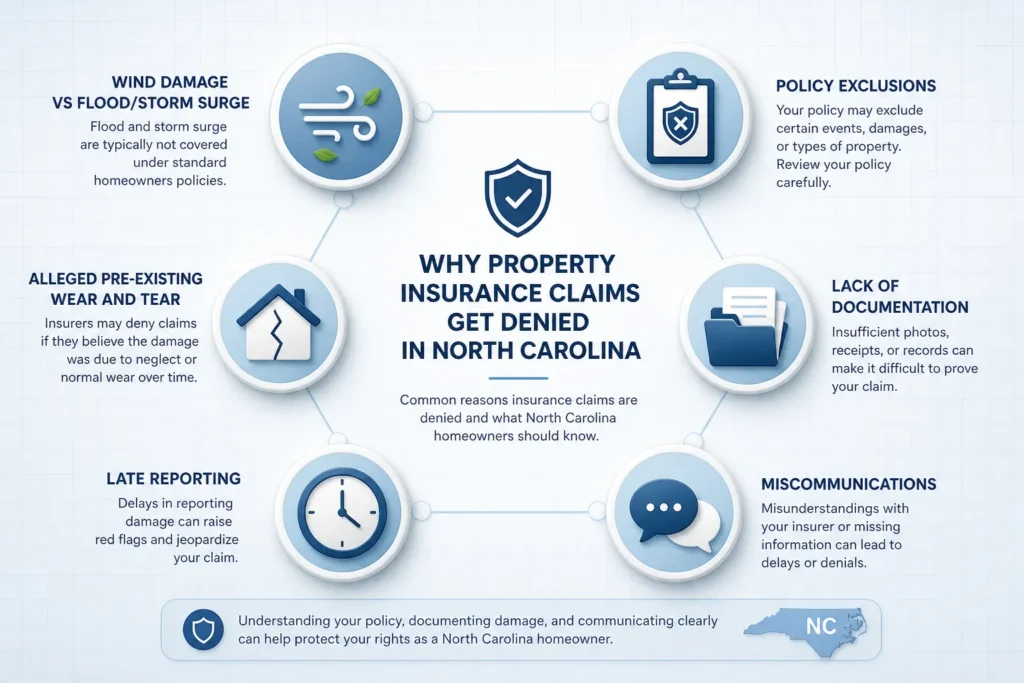
Direct answer: insurers commonly lean on policy exclusions, wind-versus-flood arguments, alleged pre-existing wear, missing paperwork, or undervalued repair costs to deny or shrink a payout.
• Flood and storm surge exclusions: standard policies cover wind but not flood, which is usually separate coverage through the National Flood Insurance Program, per FEMA
• Anti-concurrent causation clauses: if wind and flood both contributed, some policies let insurers limit or deny the claim entirely
• Missing documentation: without clear photos, estimates, and mitigation receipts, carriers may deny or lowball parts of a claim
• Alleged pre-existing wear: older coastal roofs near the water soak up salt air for years, making them an easy target for age-related, not storm-related arguments, even when you remember the damage happening during the storm
• Late reporting, non-payment of premiums, or inconsistent statements between your report, the adjuster, and your contractor
• Suspected fraud: in rare cases, if the insurer believes damage was exaggerated, it may deny the claim and refer it for investigation
The Insurance Information Institute outlines common claim-handling issues like these. In practice, an underpayment can hurt as much as a denial, since the house still won’t get fixed without more money from somewhere. Insurers tend to slice each line item, while we look at the whole repair scope — roof, drywall, flooring, mechanicals, mold — rather than arguing over individual shingles.
First Steps and NC Complaint Options After a Denial
Direct answer: get everything in writing, preserve evidence, compare the denial to your actual policy, and respond in writing while deciding whether to keep fighting, get help, or explore selling.
• Request the full denial letter, adjuster’s report, and any engineering reports the insurer relied on
• Take date-stamped photos and videos of roof damage, interior walls and floors, mold, and high-water lines before major demolition begins
• Compare the denial to your policy’s coverage grants, exclusions, and hurricane deductible language
• Clarify whether it’s a full denial, partial denial, or just a low offer, so you know exactly what you’re disputing
• Send a written response listing disputed items and attaching your evidence, and ask for reconsideration
The North Carolina Department of Insurance runs a formal complaint process if the insurer isn’t responding, is giving conflicting explanations, or seems to be misapplying your policy. To file, you typically need your contact and policy information, a copy of the denial letter, and a timeline of events. Legal Aid of North Carolina offers guidance on claims and appeals for NC residents, and a private attorney can advise on deadlines or bad-faith concerns for more complex disputes.
Insurers generally expect reasonable temporary repairs, like tarping the roof or pumping out water, to prevent further damage — document everything thoroughly before major demolition begins. Some homeowners quietly request a no-obligation cash offer just to know their walk-away number before investing more time in appeals. Our breakdown of costs you may face when selling your house in Wilmington can help with that comparison.
Wind vs. Flood: How Storm Surge Disputes Affect NC Claims
Direct answer: many coastal NC claims get denied or underpaid because insurers push damage into the excluded flood or storm surge category instead of the typically-covered wind category. Wind and water often hit together, which is exactly what fuels the dispute.
| Damage Type | Typical Signs | Usually Covered By |
| Wind | Missing shingles, torn roofing, blown-in windows, siding ripped off | Homeowners insurance |
| Flood / storm surge | Waterlines on walls, mud and silt, debris pushed in, buckled floors | Separate flood insurance |
FloodSmart confirms flood insurance is separate from homeowners coverage and can include storm surge, which is why the label an adjuster assigns to your damage matters so much. A few things help your case without needing to become an expert:
• Save timestamped photos and videos taken right after the storm
• Note whether roof or siding damage appeared before water started rising
• Keep weather alerts or radar screenshots showing wind speed and direction
• Ask neighbors what they observed about your roof or exterior early in the storm
We focus on the physical condition of the house — roof, framing, mold, finishes — and price in repairs for both wind and water damage rather than waiting for the paperwork fight to resolve. In real coastal storms, wind and water often show up together, and some insurers try to count as much damage as possible as excluded flood instead of covered wind. See our guide on selling a house with water damage in NC for more.
How to Appeal a Denied Claim and Avoid Costly Mistakes
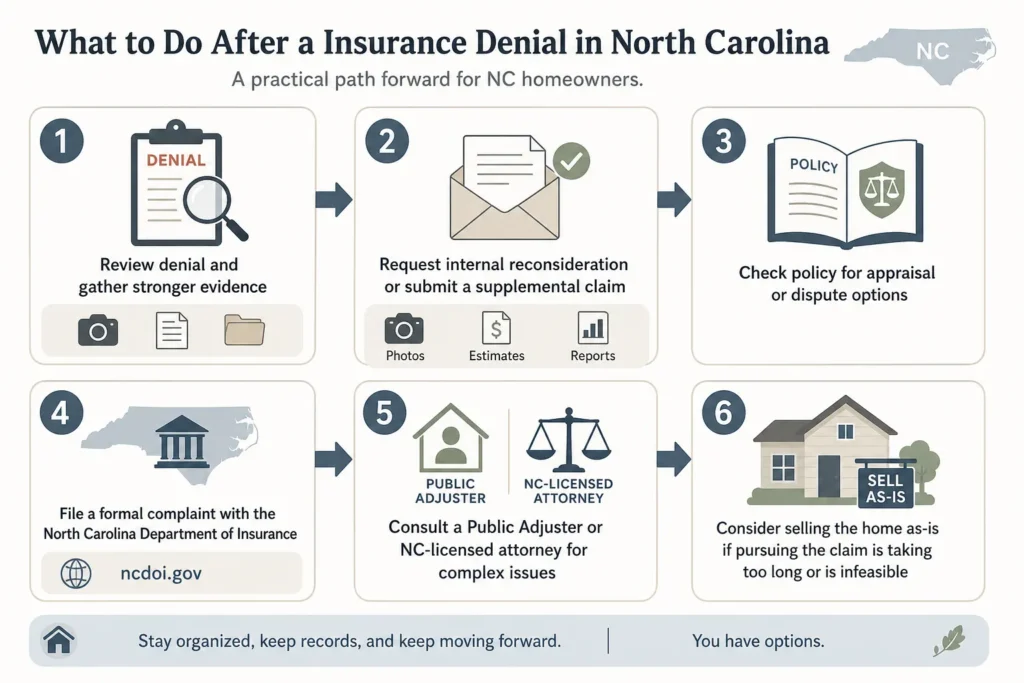
Direct answer: you can often appeal a denied hurricane claim in North Carolina by gathering stronger evidence, requesting reconsideration, using your policy’s appraisal clause, filing an NCDOI complaint, or hiring a public adjuster or attorney.
• Send a written reconsideration request referencing your claim number and attaching new evidence
• Check your policy for an appraisal clause, where each side picks an appraiser and they select an umpire to set the loss value
• File a complaint with the North Carolina Department of Insurance if the insurer isn’t responding or applying your policy correctly
• Consider a licensed public adjuster, who works for you — the NC DOI public adjuster guide explains how they’re regulated
• Talk with an NC-licensed attorney if coverage is flatly denied or bad faith is suspected
While appealing, avoid common mistakes: demolishing before documenting damage, missing appeal deadlines, relying only on phone conversations with the adjuster, or signing a release for a small check without understanding what you’re giving up. These steps take real time and energy, which is why some homeowners pursue an appeal while also getting a firm number for selling as-is. Read our How We Buy Houses page if you want a real cash number to compare against your claim path.
When to Stop Fighting and Sell As-Is
Direct answer: if you’re seeing repeated small supplements, worsening mold or structural damage, or health effects from a half-repaired house, it may be time to consider selling instead of continuing the fight.
| Path | What It Involves |
| Keep fighting | NCDOI complaints, public adjusters, attorneys, more documentation |
| Self-fund repairs | Ongoing costs, disruption, and project management over time |
| Sell as-is | Cash sale, no repairs, closing costs and cleanup often covered by the buyer |
A strong claim outcome on paper can look different after months of mortgage payments, taxes, temporary housing, and unreimbursed repairs. Trying to sell a heavily damaged home through traditional channels can be tough, since many banks won’t finance a house without a functional roof or finished walls. With ILM Home Offer, selling as-is typically means a short conversation, a walkthrough or photos, a cash offer within 48 hours, and a closing where we cover normal closing costs and cleanup. This path is common for inherited coastal cottages, rentals with tarped roofs and no tenants, or owners relocating after a storm.
There is no single right answer for every homeowner, but there is a point where hanging on to a severely damaged coastal house costs more in money, health, and stress than it is worth. For the bigger financial picture, see our costs you may face when selling your house in Wilmington and Wilmington real estate market trends guides.
Why a Local Cash Buyer Can Be the Simpler Path
Direct answer: a local cash buyer skips lender approval, strict repair appraisals, and underwriters worried about flood zones — we price tarped roofs and gutted interiors into a straightforward offer instead.
• We buy coastal storm and hurricane-damaged homes as-is, including open claim files and mold concerns
• We cover closing costs and cleanup, so you’re not writing checks to get out of the house
• We decide based on our own walkthrough and local repair costs, not bank approval
Denials, underpayments, wind-versus-flood disputes, and unsafe living conditions are all things we’re used to seeing. Instead of solving each one on paper, we convert the actual condition of the house into a cash number on a predictable timeline. You do not have to choose between fighting forever and walking away with nothing — selling to a local cash buyer is one more path that can turn a storm-damaged property into a clean exit. Check our Where We Buy Houses page to see if we serve your area, or request a cash offer for your hurricane-damaged North Carolina home directly.
FAQ: Hurricane Insurance Claim Denied in North Carolina
Why are hurricane claims so often denied in coastal North Carolina?
Insurers often cite flood-versus-wind arguments, exclusions, pre-existing wear, or missing documentation. A denial is the insurer’s position, not a final verdict — NC DOI and Legal Aid NC can help with appeal options.
Can I appeal a denied hurricane claim in North Carolina?
Yes. Start by reviewing the denial, gathering stronger evidence, and requesting reconsideration. If unresolved, file an NCDOI complaint or talk with an NC-licensed attorney about deadlines and options.
What’s the difference between a denied claim and an underpaid one?
A denial means the insurer says damage isn’t covered. An underpayment means it accepts coverage but offers less than repairs cost. Both can be challenged with stronger documentation or professional help.
Should I hire a public adjuster or a lawyer?
Public adjusters focus on documenting damage and negotiating claim amounts. Attorneys matter more when coverage is denied outright or bad faith is suspected. We’re a buyer, not either — get independent claim advice.
Can I sell my hurricane-damaged home as-is after a denial?
Yes. We buy hurricane-damaged NC homes as-is, factoring repairs and claim uncertainty into the offer, with a cash offer typically within 48 hours and closing costs covered.
Do I need to repair anything before selling to ILM Home Offer?
No. We purchase homes as-is, including tarped roofs and mold concerns. Letting us see the full damage through a walkthrough or photos just helps our offer reflect the real work involved.
Will a denied or disputed claim scare off a cash buyer like ILM Home Offer?
No. We regularly buy homes with denied, underpaid, or still-appealing claims. Our focus is the property’s condition and your situation, not whether the insurer agreed with you.
You’ve made it through a hurricane and the gut punch of a denied or underpaid claim. A denial is not always the final word — but if you’re ready to see what walking away looks like, request a cash offer for your hurricane-damaged North Carolina home and we’ll give you a straight answer.